Pamela Colman Smith
Two of Cups Tarot Card Meaning
Look for an exchange both people can enter
The Two of Cups centres an exchange between two participants. It can invite attention to listening, affection, cooperation or making an agreement together. The important question is whether both people have room to offer something, respond and express their own needs.
Upright meaning
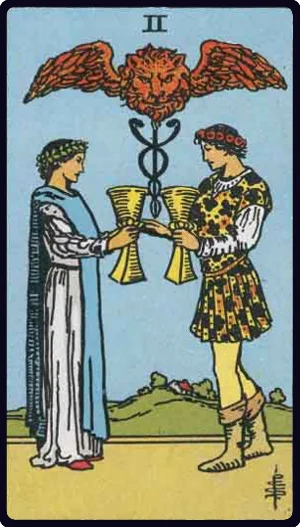
Read the facing figures as a prompt for mutual attention. One person speaks and the other has an opportunity to answer; a proposal is offered and can be discussed. Connection becomes clearer through that exchange, rather than through one person's hopes about what it means.
Reciprocity does not require identical contributions at every moment. People may offer different kinds of support or have different amounts of time. What matters is whether the arrangement is understood, freely entered and open to revision.
Reversed meaning
Reversed, an exchange may be out of balance or based on different assumptions. Someone may think a plan is agreed while the other person is still considering it. Put the expectations into words before interpreting the gap as a fixed problem with the relationship.
The card can also invite you to notice your own part in a conversation. Are you agreeing before considering the request, or waiting for someone to infer a need you have not stated? A clearer exchange may begin with one honest sentence rather than a dramatic declaration.
What to notice in the image
Start with what is pictured, then try the reading prompt. An image detail and an interpretation are different kinds of information.
- Two cups held between people
Each figure holds a cup while facing the other.
Reading prompt: What is each person offering, and is there space for a genuine response?
- The space between the figures
The figures remain separate while reaching toward the exchange.
Reading prompt: Connection can include closeness and distinct preferences. What needs to remain a choice for each person?
Love and relationships
Upright
The Two can support a direct conversation about affection, expectations or the next step you both want. Notice consistency between words and participation. A meaningful exchange may concern a friendship or a partnership as well as romance.
Reversed
Discuss the specific mismatch: who initiates contact, what a promise meant or how a decision was made. If one person does not want the same connection, more interpretation cannot create mutual agreement. Let their stated answer inform your choices.
Work and practical resources
Upright
A collaboration benefits from a clear exchange of skills, responsibilities and expectations. Before beginning, agree on what each person will contribute and how changes will be discussed. A friendly conversation is a good start, but it does not replace that agreement.
Reversed
Check whether the arrangement has shifted without being discussed. One person may be doing extra work while the other believes the original division still applies. Describe the change and ask for a concrete adjustment.
Time, attention and materials
Name the support each person can realistically offer. Time, access, attention and practical help can all be valuable without being exactly interchangeable.
A worked reading
Question: How can I talk to a friend about always being the one who makes plans?
You enjoy meeting your friend, but arranging every visit is beginning to feel one-sided. The Two appears as Advice.
Focus on the exchange rather than guessing how much your friend cares. Explain that you would appreciate them suggesting the next meeting, then ask what makes planning easy or difficult for them. Perhaps they can take turns choosing a date, or perhaps their availability is different from yours. The next step is an explicit arrangement you can both try and review.
Change the position
As a Situation, the Two may describe a cooperative exchange already happening. As an Obstacle, it can ask whether preserving an image of perfect agreement is keeping either person from naming a difference.
Distinguish this card from nearby themes
Two of Cups and Ace of Cups
The Ace concerns an emotional opening; the Two concerns participation in an exchange. A strong feeling on one side does not automatically establish the mutuality pictured by the Two.
Compare: Ace of Cups
Two of Cups and Ten of Cups
The Two focuses on an exchange between participants. The Ten widens attention to belonging and the kind of shared life or community people want to sustain. A good conversation and an ongoing shared environment ask different questions.
Compare: Ten of Cups
Take the reading into practice
Reflect: What have we agreed together, and what have I only assumed?
Try: Put one expectation into words and ask the other person how they understand it.
Frequently asked questions
Does the Two of Cups prove we are soulmates?
No. The image is useful for reflecting on mutual attention and connection, but it cannot certify a destined relationship. Assess the relationship through the choices and behaviour of both people.
Does the Two of Cups reversed always mean a breakup?
It can prompt a look at a mismatch, unclear expectations or an unbalanced exchange. Those themes do not determine whether a relationship ends. The actual circumstances and each person's choices matter.
Read within the suit
Cups use Water as a symbolic element in this guide. Feelings, relationships and the experience of connection. The individual image gives the reading its focus; a rank or an element does not set a calendar date.
Use a physical deck or choose a card from the Cups list to practise. The site’s Daily Draw, Three-Card Spread and Yes/No Oracle use only the 22 Major Arcana, so this Minor card is not an available draw result.
Sources and interpretation
Historical image descriptions: A. E. Waite, The Pictorial Key to the Tarot, Part III, section 2, the suit of Cups.
The observations refer to the card displayed above. The practical readings, comparison prompts and worked scenario are Lumina Tarot’s modern editorial interpretations. They do not reproduce every historical meaning, and reversal conventions vary. See our approach and correction process.