Pamela Colman Smith
Ace of Cups Tarot Card Meaning
Make room for a feeling to begin
The Ace of Cups gives a new feeling room to be noticed. It can suggest affection, compassion, creative pleasure or the willingness to receive support. Read it as an opening you can respond to, before you know what form the experience will take.
Upright meaning
An emotional beginning does not have to be dramatic. You might enjoy a conversation, feel moved by something you make or realise that you want more connection in your day. The Ace invites you to acknowledge that response without immediately requiring a label or a long-term promise.
Receiving is part of the theme. If someone offers a kindness, consider whether you want to accept it and what would feel comfortable. Openness can be selective and gradual; it need not mean telling a new acquaintance everything or agreeing to an unwanted invitation.
Reversed meaning
Reversed, a feeling may be private, difficult to express or arriving when your attention is already full. Ask whether you need a way to name it, a quieter setting or more time before sharing it. A feeling can matter even when it is not ready to become a conversation.
The reversal can also prompt a check on how much care you are offering. If giving has become automatic, notice what you can sustain and what you would welcome in return. An overflowing cup is a useful image for abundance, but your time and energy still have limits.
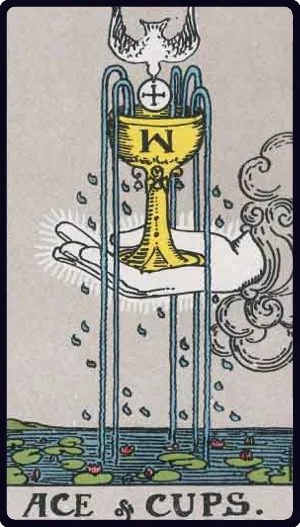
What to notice in the image
Start with what is pictured, then try the reading prompt. An image detail and an interpretation are different kinds of information.
- Water spilling from the cup
Streams fall from the cup toward the water below, where lilies grow.
Reading prompt: What feeling is becoming noticeable, and what simple form could help you acknowledge it?
- The supporting hand
An open hand holds the cup from beneath rather than gripping its stem.
Reading prompt: Consider what support would help you receive an experience without having to control its outcome.
Love and relationships
Upright
The Ace can focus on readiness for affection or a fresh moment of warmth in an existing relationship. Express one sincere interest or appreciation and allow the other person to respond freely. Your own openness is something you can recognise; mutual commitment needs participation from both people.
Reversed
If affection is difficult to express, choose a manageable way to begin: a kind sentence, a clear invitation or a conversation about what feels comfortable. If you do not want the connection being offered, you can acknowledge the gesture without accepting it.
Work and practical resources
Upright
Notice what makes a task feel meaningful: the people it serves, a creative element or a supportive exchange with a colleague. That feeling can help you choose how to engage with the work, alongside the practical requirements of the role.
Reversed
An emotionally rewarding task can become draining when you feel responsible for everyone's experience. Identify what belongs to your role and where support from others would help. Care is more useful when it has a workable form.
Time, attention and materials
Leave some uncommitted time for an activity or connection you want to explore. A modest opening in the week may be enough to discover whether it feels nourishing.
A worked reading
Question: How can I begin making friends after moving to a new neighbourhood?
You enjoyed talking with someone at a local class but feel pressure to know immediately whether a close friendship will develop. The Ace appears as Advice.
Let the cup represent the small, real feeling of enjoying the conversation. Say you liked meeting them and offer a simple opportunity to talk again after the next class. You are giving the connection room to develop, not asking the first exchange to prove its future. Afterwards, notice whether contact feels comfortable and whether interest is returned over time.
Change the position
As a Situation, the Ace could describe a new feeling already present. As an Obstacle, it might ask whether expecting an intense emotional beginning is making you overlook quieter forms of connection.
Distinguish this card from nearby themes
Ace of Cups and Two of Cups
The Ace concerns an opening or feeling becoming available. The Two examines an exchange between people. Your readiness to connect and another person's willingness to participate are separate things to observe.
Compare: Two of Cups
Ace of Cups and Page of Cups
The Ace opens the possibility of feeling; the Page explores how to recognise or express it. If the feeling is already clear, the Page can help frame a modest first expression.
Compare: Page of Cups
Take the reading into practice
Reflect: What feeling would I like to acknowledge without deciding its whole future?
Try: Give that feeling one modest expression: a note, a conversation or time for an activity you care about.
Frequently asked questions
Does the Ace of Cups mean someone loves me?
It can invite reflection on affection and openness, but it does not establish another person's feelings. Look for what they communicate and how they participate in the connection.
Is the Ace of Cups a pregnancy prediction?
No. Some symbolic traditions connect cups and beginnings with fertility, but a tarot card cannot establish pregnancy. This guide reads the Ace around emotional openness, care and creative beginnings.
Read within the suit
Cups use Water as a symbolic element in this guide. Feelings, relationships and the experience of connection. The individual image gives the reading its focus; a rank or an element does not set a calendar date.
Use a physical deck or choose a card from the Cups list to practise. The site’s Daily Draw, Three-Card Spread and Yes/No Oracle use only the 22 Major Arcana, so this Minor card is not an available draw result.
Sources and interpretation
Historical image descriptions: A. E. Waite, The Pictorial Key to the Tarot, Part III, section 2, the suit of Cups.
The observations refer to the card displayed above. The practical readings, comparison prompts and worked scenario are Lumina Tarot’s modern editorial interpretations. They do not reproduce every historical meaning, and reversal conventions vary. See our approach and correction process.