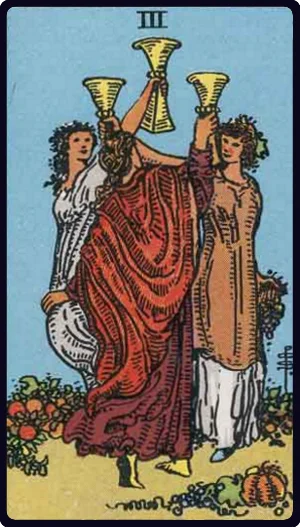
Pamela Colman Smith
Three of Cups Tarot Card Meaning
Let enjoyment and support be shared
The Three of Cups brings attention to friendship, shared enjoyment and the support of a group. It can invite you to mark a moment together or notice the people with whom you can relax. Belonging depends on how the gathering feels to its participants, not simply on being included in a busy social calendar.
Upright meaning
Shared pleasure can be valuable in its own right. A meal, a familiar activity or a conversation without an agenda can help people reconnect. You do not need a major achievement to justify spending time with those whose company you enjoy.
The card also invites appreciation for a wider circle of support. Different friends may share different parts of your life. Notice who contributes to that sense of connection and how you can take part without expecting one person to meet every social need.
Reversed meaning
Reversed, a group experience may leave someone outside the circle or ask for more social energy than they have available. Check the format, timing and expectations before assuming the friendship itself is the problem.
Another possibility is a gathering that looks enjoyable but leaves little room for honest participation. You might be agreeing to every invitation, keeping up with an expensive routine or avoiding a necessary conversation through constant activity. A smaller or clearer arrangement may fit better.
What to notice in the image
Start with what is pictured, then try the reading prompt. An image detail and an interpretation are different kinds of information.
- The raised cups
Three people lift their cups toward a shared centre.
Reading prompt: What experience can people enjoy together, and does each person have a place in it?
- Fruit and growing plants
Produce and flowers appear around the figures' feet.
Reading prompt: Consider what the gathering draws on: past effort, shared interests or the simple pleasure of spending time together.
Love and relationships
Upright
The Three can invite a healthy place for friendships alongside a romantic connection. Shared company may bring enjoyment, while separate friendships can remain valuable too. Talk about what social time feels welcome rather than assuming everyone wants the same amount.
Reversed
A social arrangement may be causing tension through exclusion, different expectations or lack of private time. Discuss the observable issue. The presence of three figures does not establish an affair or a romantic triangle.
Work and practical resources
Upright
Make room to recognise a collective effort and the informal support that helped it happen. A simple thank-you or a relaxed shared break can matter. Consider whether the people doing less visible work are included in the acknowledgement.
Reversed
An optional social event may feel compulsory, or a close group may make it hard for newcomers to join. Offer more than one way to participate and avoid treating attendance as proof of commitment to the work.
Time, attention and materials
Choose a gathering that fits the group's time, energy and circumstances. Connection does not depend on everyone spending the same amount or staying for the same length of time.
A worked reading
Question: How can our friends reconnect when everyone has different schedules?
The group keeps proposing elaborate weekends that few people can attend, then feels disappointed when plans collapse. The Three appears as Advice.
Keep the shared centre of the image in mind: the purpose is to enjoy each other's company. Try a short, simple gathering with clear details and no pressure to stay all day. Invite suggestions for another time from anyone who cannot join. A workable rhythm of smaller meetings may serve the friendship better than one ideal event that never happens.
Change the position
As a Situation, the Three may describe support already available in a group. As an Obstacle, it can ask whether following the group's preferred routine is crowding out your own needs or someone else's chance to participate.
Distinguish this card from nearby themes
Three of Cups and Two of Cups
The Two examines a direct exchange between participants. The Three looks at the experience of a wider circle. A personal misunderstanding may need a one-to-one conversation even when the group itself is supportive.
Compare: Two of Cups
Three of Cups and Ten of Cups
The Three often centres a shared moment of enjoyment. The Ten asks about a continuing sense of belonging. A pleasant gathering can support that belonging, but it does not tell you how the whole community functions over time.
Compare: Ten of Cups
Take the reading into practice
Reflect: Which kind of shared time leaves me feeling included and able to be myself?
Try: Suggest one simple way to spend time together, with room for people to join, decline or propose an alternative.
Frequently asked questions
Does the Three of Cups mean a third person is involved in my relationship?
No. Three figures are not evidence of infidelity. This guide reads the image around friendship, group participation and shared enjoyment; concerns about a relationship need to be addressed through real information.
What if I prefer a small social circle?
The theme can fit a quiet meal with trusted friends or a shared activity. You do not need a large group, frequent parties or a particular social style to explore the card's meaning.
Read within the suit
Cups use Water as a symbolic element in this guide. Feelings, relationships and the experience of connection. The individual image gives the reading its focus; a rank or an element does not set a calendar date.
Use a physical deck or choose a card from the Cups list to practise. The site’s Daily Draw, Three-Card Spread and Yes/No Oracle use only the 22 Major Arcana, so this Minor card is not an available draw result.
Sources and interpretation
Historical image descriptions: A. E. Waite, The Pictorial Key to the Tarot, Part III, section 2, the suit of Cups.
The observations refer to the card displayed above. The practical readings, comparison prompts and worked scenario are Lumina Tarot’s modern editorial interpretations. They do not reproduce every historical meaning, and reversal conventions vary. See our approach and correction process.