Pamela Colman Smith
Ten of Cups Tarot Card Meaning
Build a version of belonging people can actually share
The Ten of Cups considers the kind of shared life in which people feel they belong. It can invite attention to family, friendship, a household or a chosen community. The image offers a picture of harmony to explore; it does not prescribe one household structure or promise a life without disagreement.
Upright meaning
Ask what makes belonging tangible in this setting: being heard, sharing ordinary time, helping with responsibilities or welcoming different needs. Shared values become useful when they can be seen in how people treat each other.
A sense of fulfilment can include imperfection. People may disagree about details while remaining committed to a workable relationship or community. The card encourages you to identify what supports that connection and what deserves to be maintained.
Reversed meaning
Reversed, the picture of harmony may differ from the experience of some participants. An occasion can look happy while someone feels excluded, overburdened or unable to express a preference. Ask whose version of a good shared life is setting the terms.
The reversal can also invite a new definition of belonging. A household or community may be changing, and an earlier arrangement may no longer fit. You can preserve meaningful connections while revising the form they take.
What to notice in the image
Start with what is pictured, then try the reading prompt. An image detail and an interpretation are different kinds of information.
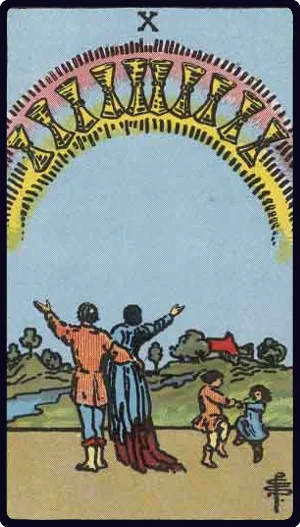
- The rainbow of cups
Ten cups form an arc in a rainbow above the figures.
Reading prompt: What shared hope does the group hold, and how could it be expressed in an ordinary, practical arrangement?
- Different activity in the same scene
The adults look upward while the children play nearby, with a house in the distance.
Reading prompt: People can belong together without enjoying the same activity in the same way. Which differences need room?
Love and relationships
Upright
The Ten can prompt discussion of what a satisfying shared life means to each person. Talk about everyday routines, friendships, responsibilities and future preferences. An appealing picture of togetherness becomes more useful when both people can help define it.
Reversed
A mismatch in expectations deserves a clear conversation rather than a performance of happiness. Ask which arrangements can change and which differences are important to acknowledge. The card does not establish that a family or relationship is broken.
Work and practical resources
Upright
In a work setting, consider shared values and whether people experience the collaboration as supportive. Clear roles, respectful communication and room for different circumstances give a positive group culture practical substance.
Reversed
Claims that a team is one happy family can make it difficult to raise ordinary concerns. Focus on specific working arrangements and fair expectations. A sense of community should allow people to discuss a problem without having to prove loyalty first.
Time, attention and materials
Include the less visible work that supports shared enjoyment: preparation, cleaning, arranging and remembering. A satisfying occasion is easier to repeat when that work is recognised and reasonably shared.
A worked reading
Question: How can our family gathering feel good for everyone rather than just look successful?
One person wants a full day of activities, another needs quiet breaks and the host usually does all the preparation. The Ten appears as Advice.
Ask each person what matters most and use the answers to design a simpler gathering. Share preparation, leave some activities optional and make room for different arrival or departure times. The aim is an experience people can actually enjoy together, not reproducing a perfect photograph of family harmony. Afterwards, ask what should be kept or changed next time.
Change the position
As a Situation, the Ten may describe a supportive sense of belonging. As an Obstacle, it can ask whether protecting an ideal image is preventing people from naming the changes that would make the real arrangement more comfortable.
Distinguish this card from nearby themes
Ten of Cups and Nine of Cups
The Nine asks what satisfies you personally. The Ten asks how people can share a life or environment that feels fulfilling. The second question needs several perspectives rather than assuming one person's preference represents everyone.
Compare: Nine of Cups
Ten of Cups and Three of Cups
The Three highlights a shared moment of friendship or celebration. The Ten looks at a more continuing sense of belonging. An enjoyable event can contribute to that pattern, but it is not the whole pattern.
Compare: Three of Cups
Take the reading into practice
Reflect: Whose idea of a happy shared life have we been using?
Try: Ask the people involved to name one thing that helps them feel included, then agree on one practical adjustment.
Frequently asked questions
Does the Ten of Cups mean marriage and children?
Those are elements some readers connect with its illustrated household, but they are not required outcomes or the only forms of fulfilment. The theme can apply to a couple, friends, chosen family or another supportive community.
Does the reversed Ten of Cups predict divorce?
No. It can prompt attention to different expectations, an uncomfortable group dynamic or a changing definition of belonging. Decisions about a relationship depend on the actual people and circumstances.
Read within the suit
Cups use Water as a symbolic element in this guide. Feelings, relationships and the experience of connection. The individual image gives the reading its focus; a rank or an element does not set a calendar date.
Use a physical deck or choose a card from the Cups list to practise. The site’s Daily Draw, Three-Card Spread and Yes/No Oracle use only the 22 Major Arcana, so this Minor card is not an available draw result.
Sources and interpretation
Historical image descriptions: A. E. Waite, The Pictorial Key to the Tarot, Part III, section 2, the suit of Cups.
The observations refer to the card displayed above. The practical readings, comparison prompts and worked scenario are Lumina Tarot’s modern editorial interpretations. They do not reproduce every historical meaning, and reversal conventions vary. See our approach and correction process.