Pamela Colman Smith
Six of Cups Tarot Card Meaning
Take something useful from the past into the present
The Six of Cups turns attention toward memory, familiar pleasures and gestures of kindness. It can invite you to revisit something that mattered or recognise how an earlier experience shapes the present. The question is what you want to carry forward, without requiring the past to return unchanged.
Upright meaning
A familiar activity, object or place may reconnect you with something you still value. Notice the specific quality: playfulness, generosity, comfort or time spent with someone. You may be able to bring that quality into your present life in a different form.
Memory is selective, so use it as a starting point for reflection rather than a complete record. A tradition can hold meaning while also containing parts you do not want to repeat. You can choose what remains useful.
Reversed meaning
Reversed, an old role or expectation may no longer fit. People may still relate to you as you were years ago, or you may be measuring the present against an idealised version of a former experience. Name what has changed and what you need now.
The reversal can also invite a more flexible relationship with a memory. You might keep an object, tell a story or adapt a familiar ritual without rebuilding the circumstances around it. Moving on does not require deciding that the past was meaningless.
What to notice in the image
Start with what is pictured, then try the reading prompt. An image detail and an interpretation are different kinds of information.
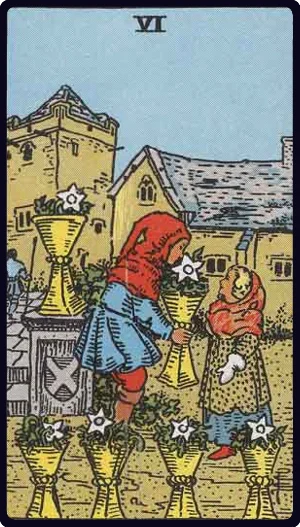
- The offered cup of flowers
One figure extends a flower-filled cup toward another.
Reading prompt: What simple kindness or shared pleasure could be repeated in a form that suits the present?
- The courtyard and cups
Several cups containing flowers stand within a setting of walls and buildings.
Reading prompt: A familiar setting can shape expectations. Which part of its meaning belongs to your memory, and which part still fits your life now?
Love and relationships
Upright
The Six can prompt a conversation about shared memories, familiar habits or an earlier influence on how you connect. Enjoying a memory does not require a relationship to return to an old stage. Ask which qualities you both want to preserve and what has changed.
Reversed
If an old relationship is on your mind, distinguish missing the person from missing a particular time or feeling. Any renewed contact needs present-day willingness and compatibility. Nostalgia alone cannot tell you whether reconnecting would suit either person now.
Work and practical resources
Upright
An earlier method or skill may be useful to revisit. Ask what worked about it and whether those conditions still apply. A good past experience can supply a starting point without becoming a rule that every new project must follow.
Reversed
A familiar process may be kept mainly because it is familiar. Invite people to explain what it still contributes and what now creates extra work. Updating a method does not dismiss the effort that originally made it valuable.
Time, attention and materials
Reuse what still serves a purpose, while making room for present needs. A familiar tool, recipe or activity may provide enjoyment without requiring a complete return to an earlier routine.
A worked reading
Question: How can I keep a family cooking tradition when our lives have changed?
You want to recreate a large meal exactly as you remember it, but the people, schedules and available space are different. The Six appears as Advice.
Look for the quality inside the memory: making something together, telling familiar stories or sharing a particular dish. Choose one part the current group would enjoy and adapt the rest. You might cook a smaller version and invite people to add something of their own. The tradition can stay meaningful because it is being shared now, not because every detail matches the past.
Change the position
As a Situation, the Six may describe familiarity influencing a present choice. As an Obstacle, it could ask whether trying to reproduce an earlier experience is preventing you from meeting the people and circumstances in front of you.
Distinguish this card from nearby themes
Six of Cups and Five of Cups
The Five centres disappointment or loss. The Six centres memory and the qualities carried from an earlier experience. Looking back can contain both, but appreciating a memory is different from processing a specific loss.
Compare: Five of Cups
Six of Cups and Page of Cups
The Six revisits familiar experience; the Page approaches a feeling or idea with fresh curiosity. A useful reading might ask whether an old interest needs to be remembered or rediscovered without old expectations.
Compare: Page of Cups
Take the reading into practice
Reflect: Which quality from this memory would I like more of now?
Try: Choose one part of a familiar activity to keep and one part to adapt to your current life.
Frequently asked questions
Does the Six of Cups mean my ex will return?
No. Past connections are one possible context, but the card cannot predict contact or another person's wishes. If reconnection is being considered, assess the present circumstances and both people's stated interest.
What if my childhood memories are not happy?
You do not have to treat the image as a description of your own childhood. It can instead prompt a question about familiarity, a kind gesture or what you choose to carry forward. You can set aside a reading that does not fit.
Read within the suit
Cups use Water as a symbolic element in this guide. Feelings, relationships and the experience of connection. The individual image gives the reading its focus; a rank or an element does not set a calendar date.
Use a physical deck or choose a card from the Cups list to practise. The site’s Daily Draw, Three-Card Spread and Yes/No Oracle use only the 22 Major Arcana, so this Minor card is not an available draw result.
Sources and interpretation
Historical image descriptions: A. E. Waite, The Pictorial Key to the Tarot, Part III, section 2, the suit of Cups.
The observations refer to the card displayed above. The practical readings, comparison prompts and worked scenario are Lumina Tarot’s modern editorial interpretations. They do not reproduce every historical meaning, and reversal conventions vary. See our approach and correction process.