Pamela Colman Smith
Page of Cups Tarot Card Meaning
Meet a new feeling with curiosity
The Page of Cups meets an unexpected feeling or idea with curiosity. It can invite a gentle first expression: a question, a creative experiment or a sincere note. This court card describes an approach that anyone can use, rather than a fixed age, gender or personality type.
Upright meaning
Notice a response before deciding what it must mean. Something may have moved you, surprised you or sparked an image you want to explore. A little curiosity can help you find words for the experience without turning it into a large declaration.
The Page also gives room for imperfect expression. A simple, accurate sentence may communicate more than an elaborate message designed to remove every possibility of misunderstanding. Share what is yours to share and allow the other person to respond in their own way.
Reversed meaning
Reversed, self-consciousness may be making a first expression feel unusually risky, or imagination may be filling in a response before one has been given. Separate what you feel from the story you are creating around how someone else will receive it.
Another possibility is sharing before you have understood what you want to say. Write a private draft or return to the idea later. Giving a feeling time to become clear is different from dismissing it as unimportant.
What to notice in the image
Start with what is pictured, then try the reading prompt. An image detail and an interpretation are different kinds of information.
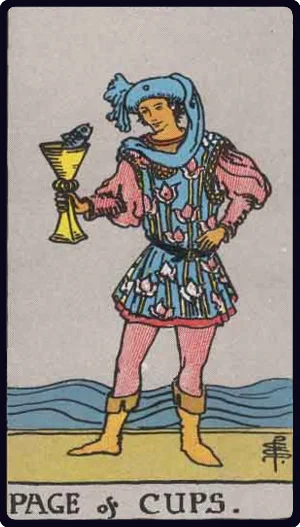
- The fish in the cup
A fish rises from the cup and faces the figure holding it.
Reading prompt: What unexpected thought or feeling deserves a curious look before you explain it away?
- The figure's attention
The figure turns toward the cup rather than looking out at the water behind.
Reading prompt: What can you learn by attending to one response instead of immediately interpreting the whole situation?
Love and relationships
Upright
The Page can encourage a modest expression of affection, appreciation or interest. Say something you can stand behind without requiring a particular answer. Curiosity is helpful when it lets you learn about the other person rather than imagine their feelings for them.
Reversed
If you are reading a great deal into a small gesture, return to what was actually said or done. If you want to apologise, identify the action and its effect rather than relying on a sentimental message to communicate everything.
Work and practical resources
Upright
An imaginative idea may deserve a small draft before it is assessed as a finished proposal. Show what you are exploring and ask a focused question. A tentative contribution can still be useful when its purpose is clear.
Reversed
Feedback on an early idea can feel personal. Ask which part of the work needs clarification or development. You can take a suggestion seriously without treating it as a judgment on your ability to have worthwhile ideas.
Time, attention and materials
Keep an easy place to record ideas and feelings that arrive before they are fully formed. A short note or sketch can preserve them without requiring immediate action.
A worked reading
Question: How can I tell a friend that a small kindness mattered to me?
A friend remembered something important to you. You want to thank them but keep rewriting the message because it feels too emotional. The Page appears as Advice.
Start with the detail you actually appreciate: they remembered, checked in or made time. Say what it meant to you in a sentence that sounds like your own voice. You do not need to explain the entire friendship or predict how they will reply. The small expression gives a real feeling a clear form while leaving the exchange open.
Change the position
As a Situation, the Page may describe a feeling or idea still taking shape. As an Obstacle, it could ask whether imagining the perfect response is preventing you from making a simple, honest expression.
Distinguish this card from nearby themes
Page of Cups and Ace of Cups
The Ace opens space for a feeling; the Page investigates or expresses it. If you already know what you feel, the Page asks what small form would help you communicate or explore it.
Compare: Ace of Cups
Page of Cups and Knight of Cups
The Page tries a first expression. The Knight develops feeling into a more deliberate invitation or offer. Before making the larger gesture, consider whether its purpose and practical details are clear.
Compare: Knight of Cups
Take the reading into practice
Reflect: What is the simplest accurate way to express this feeling?
Try: Write one sentence naming the detail that moved you and why it mattered. Decide whether to share it or keep it for reflection.
Frequently asked questions
Does the Page of Cups mean an apology is coming?
An apology can be one context for an emotional message, but the card cannot predict that someone will send one. It can help you consider the expression you want to make and whether it is clear and appropriate.
Does the Page of Cups represent an immature person?
Not necessarily. Curiosity, imagination and learning to express a feeling are available at any age. Assess a person's behaviour directly rather than using a court card as a fixed character label.
Read within the suit
Cups use Water as a symbolic element in this guide. Feelings, relationships and the experience of connection. The individual image gives the reading its focus; a rank or an element does not set a calendar date.
Use a physical deck or choose a card from the Cups list to practise. The site’s Daily Draw, Three-Card Spread and Yes/No Oracle use only the 22 Major Arcana, so this Minor card is not an available draw result.
Sources and interpretation
Historical image descriptions: A. E. Waite, The Pictorial Key to the Tarot, Part III, section 2, the suit of Cups.
The observations refer to the card displayed above. The practical readings, comparison prompts and worked scenario are Lumina Tarot’s modern editorial interpretations. They do not reproduce every historical meaning, and reversal conventions vary. See our approach and correction process.