Pamela Colman Smith
Seven of Cups Tarot Card Meaning
Separate an attractive possibility from an available choice
The Seven of Cups gathers several possibilities into one enticing view. Some may be real options, others imagined outcomes, hopes or worries. Its useful question is how to preserve the value of imagination while finding out what a choice would actually involve.
Upright meaning
Generating possibilities can help when you have not yet found a direction that interests you. Let the ideas appear before deciding among them. The difficulty begins when imagining each result replaces investigating the steps that could lead to it.
Compare options using the same questions: what is available, what would it ask of you and what information is missing? An appealing image of the outcome is not yet a workable opportunity. One concrete detail can make a vague possibility much easier to assess.
Reversed meaning
Reversed, you may be ready to narrow the field and choose a practical first step. Identify which option fits your actual priorities rather than the most impressive imagined version of yourself.
The reversal can also describe cutting off imagination too quickly because uncertainty feels uncomfortable. If none of the current options fits, you may need a different option instead of forcing a choice among the first few. Clarity comes from checking assumptions, not simply reducing the list.
What to notice in the image
Start with what is pictured, then try the reading prompt. An image detail and an interpretation are different kinds of information.
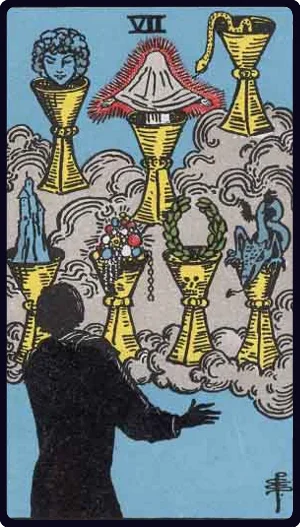
- Different contents in each cup
The cups contain unlike objects and figures, including jewels, a wreath and a building.
Reading prompt: What is attractive about each possibility, and are you comparing the same kind of benefit?
- The bank of clouds
The cups appear within clouds above the silhouetted figure.
Reading prompt: Which parts of the choice are known, and which still exist mainly in your imagination?
Love and relationships
Upright
The Seven can invite you to distinguish the connection you experience from the future you imagine around it. Notice what has actually been discussed and what you hope will happen. Curiosity about another person is more useful when it leaves room to discover who they are.
Reversed
You may be ready to name what you want and ask a clearer question. Avoid replacing an idealised image with a negative label when reality differs. Use specific behaviour and conversations to understand the connection.
Work and practical resources
Upright
Compare attractive projects by their everyday tasks, not only their finished appearance. Ask what a typical week would involve, what skills are needed and which resources are available. A small trial can reveal whether you enjoy the process behind the imagined result.
Reversed
If you have narrowed your options, state why the remaining choice fits. If a decision feels rushed, identify the missing fact that matters most. The aim is a defensible next step, not absolute certainty about every possible outcome.
Time, attention and materials
Distinguish researching an option from collecting more appealing options. Time spent checking one practical requirement may be more useful than saving another long list of ideas.
A worked reading
Question: Which evening class should I choose from all the ones I have saved?
You imagine enjoying pottery, photography, dance and several other activities, but have not checked the dates or what beginners actually do. The Seven appears as Advice.
Separate each attractive outcome from the available class. Check the timetable, location, materials and type of practice involved. Choose one option that fits your week and offers an introductory session, if available. After trying it, assess the experience rather than comparing it with a perfect image of all the classes you did not take.
Change the position
As a Situation, the Seven may describe a rich but untested set of possibilities. As an Obstacle, it can highlight comparing real life with imagined alternatives that have never had to meet practical constraints.
Distinguish this card from nearby themes
Seven of Cups and Four of Cups
The Four considers a lack of engagement with what is offered. The Seven considers several compelling possibilities. Ask whether the task is discovering what interests you or checking which attractive option is actually workable.
Compare: Four of Cups
Seven of Cups and Nine of Cups
The Seven looks at imagined satisfaction across possible choices. The Nine examines satisfaction you can experience or acknowledge now. An appealing future and a present sense of enough are different things to assess.
Compare: Nine of Cups
Take the reading into practice
Reflect: Which part of this option do I know, and which part have I supplied in my imagination?
Try: Choose two options and compare one concrete requirement of each before adding another possibility.
Frequently asked questions
Does the Seven of Cups mean someone is deceiving me?
No. It can prompt you to check assumptions and distinguish facts from imagined possibilities, but it does not establish another person's motives. Seek the information relevant to the actual question.
Should I stop daydreaming when this card appears?
Imagination can help you discover what attracts you. When a decision is needed, add a practical stage: identify which options exist, what they involve and one way to learn more.
Read within the suit
Cups use Water as a symbolic element in this guide. Feelings, relationships and the experience of connection. The individual image gives the reading its focus; a rank or an element does not set a calendar date.
Use a physical deck or choose a card from the Cups list to practise. The site’s Daily Draw, Three-Card Spread and Yes/No Oracle use only the 22 Major Arcana, so this Minor card is not an available draw result.
Sources and interpretation
Historical image descriptions: A. E. Waite, The Pictorial Key to the Tarot, Part III, section 2, the suit of Cups.
The observations refer to the card displayed above. The practical readings, comparison prompts and worked scenario are Lumina Tarot’s modern editorial interpretations. They do not reproduce every historical meaning, and reversal conventions vary. See our approach and correction process.