Pamela Colman Smith
Five of Cups Tarot Card Meaning
Acknowledge the disappointment before deciding what remains
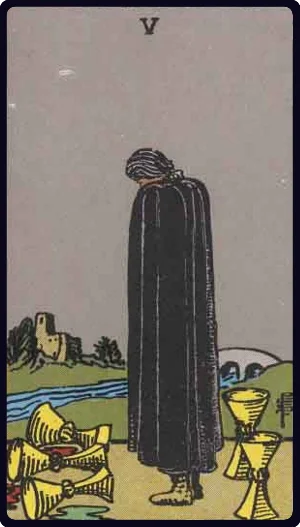
The Five of Cups brings disappointment, regret or loss into focus. Something may not have happened as you hoped, and it deserves to be acknowledged. The standing cups invite a later look at what remains available; they do not cancel the importance of what has been lost.
Upright meaning
Begin by naming the disappointment accurately. What happened, what did you expect and which part matters most? This helps separate the actual loss from the larger story you may be telling yourself about everything going wrong.
The card does not set a deadline for feeling better. Acknowledging support or another possibility can coexist with sadness. You do not have to replace a lost experience immediately or turn it into a lesson before you are ready.
Reversed meaning
Reversed, your attention may be widening enough to notice support, repair or another way forward. Look for a small sign in your actual life: a conversation you want to have, a task you can resume or an offer you are ready to consider.
Another reading is disappointment being pushed aside because you feel you should already be over it. If that fits, name what remains unresolved. Moving forward can include carrying a feeling with you while choosing a practical next step.
What to notice in the image
Start with what is pictured, then try the reading prompt. An image detail and an interpretation are different kinds of information.
- Fallen and standing cups
Three cups lie on their sides in front of the figure; two remain upright behind.
Reading prompt: Separate what has changed from what is still available. Neither list needs to erase the other.
- The bridge across the river
A bridge appears in the distance beyond the cloaked figure.
Reading prompt: What support or route could connect you with a next step when you are ready to consider it?
Love and relationships
Upright
The Five can help frame a conversation about a disappointment without making it stand for the whole connection. Explain the specific hurt or unmet expectation and listen to the response. If a relationship has ended, the card can be a prompt to notice support beyond that relationship when it feels possible.
Reversed
Repair may be worth exploring if both people want it and something concrete can change. An apology, renewed contact and a restored relationship are separate steps. You can appreciate an attempt at repair without agreeing to return to the previous arrangement.
Work and practical resources
Upright
An unsuccessful proposal or cancelled project can mean losing both a hoped-for result and work you cared about. Review the outcome when you have room to do so: what was outside your control, what can be learned and what material is still useful?
Reversed
If you are ready to reuse part of an earlier effort, choose it deliberately. If a setback is being ignored, a short, factual review may help the next project avoid the same problem. The aim is learning, not assigning blame for every disappointing result.
Time, attention and materials
Keep an accurate record of what remains usable: materials, knowledge, relationships or completed parts of the work. This is an inventory, not a demand to feel positive about the setback.
A worked reading
Question: How can I respond to a reunion being cancelled after months of planning?
You were looking forward to seeing friends and feel embarrassed by how disappointed you are. The Five appears in a Situation position.
Let the fallen cups name the specific loss: the gathering you had imagined will not happen as planned. You can tell a friend you are disappointed without minimising it. When you want to look at the standing cups, consider what contact is still possible, perhaps a call or a smaller visit later. An alternative can be worthwhile without pretending it replaces the original occasion.
Change the position
As Advice, the Five may ask you to acknowledge a disappointment before planning the next move. As an Obstacle, it could describe treating one setback as evidence that every remaining option has also disappeared.
Distinguish this card from nearby themes
Five of Cups and Eight of Cups
The Five focuses on a loss or disappointment and the response to it. The Eight considers moving away from something still present. Processing an unwanted change and choosing a change are different situations, even when both feel sad.
Compare: Eight of Cups
Five of Cups and Six of Cups
The Five attends to what has been lost; the Six attends to memory and what the past still means. Remembering a valued experience can support you, but it can also need to be separated from a decision about the present.
Compare: Six of Cups
Take the reading into practice
Reflect: What exactly am I disappointed about, and what support would feel welcome?
Try: Name the loss in one sentence. If you want to, name one person, resource or small action that remains available.
Frequently asked questions
Does the Five of Cups mean I should focus only on the positive?
No. The standing cups invite awareness of what remains, while the fallen cups still belong in the scene. A useful reading allows disappointment and available support to be acknowledged together.
Does the Five of Cups predict a breakup or bereavement?
No. It offers a symbolic way to consider disappointment or loss when those themes fit your question. It cannot identify a future event or establish that a relationship will end.
Read within the suit
Cups use Water as a symbolic element in this guide. Feelings, relationships and the experience of connection. The individual image gives the reading its focus; a rank or an element does not set a calendar date.
Use a physical deck or choose a card from the Cups list to practise. The site’s Daily Draw, Three-Card Spread and Yes/No Oracle use only the 22 Major Arcana, so this Minor card is not an available draw result.
Sources and interpretation
Historical image descriptions: A. E. Waite, The Pictorial Key to the Tarot, Part III, section 2, the suit of Cups.
The observations refer to the card displayed above. The practical readings, comparison prompts and worked scenario are Lumina Tarot’s modern editorial interpretations. They do not reproduce every historical meaning, and reversal conventions vary. See our approach and correction process.