Pamela Colman Smith
Justice Tarot Card Meaning
Compare the facts, the agreement and each person’s responsibility.
Justice can bring fair evaluation, consistency and accountability into focus. The scales invite comparison; the sword invites a clear distinction. In a reading, ask what information should guide the judgment and whether the same standard is being applied to everyone, including yourself.
Upright meaning
Justice can invite you to weigh relevant facts, examine an agreement and acknowledge your responsibilities. Ask what standard you are using to judge the situation and whether you would apply it consistently. The card does not determine an official decision.
Begin with what was agreed, what happened and what can be verified. Fairness may require hearing a perspective that is inconvenient to your preferred conclusion. A clear decision should identify the relevant standard and the responsibility that follows from it, rather than relying only on the strength of a feeling.
Reversed meaning
Consider whether important information is missing, a standard is being applied unevenly or a responsibility has been overlooked. Clarify the criteria before deciding who is right. The card is not evidence of wrongdoing.
An uneven process, missing information and reluctance to acknowledge your own part can all complicate evaluation. Do not assume the reversal identifies which person is at fault. Name the possible gap, seek the relevant record and distinguish a disagreement about the facts from a disagreement about the standard being used.
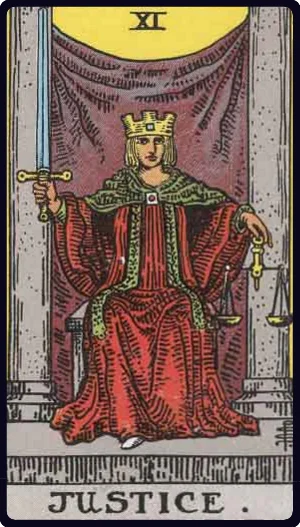
What to notice in the image
The first description names a visible detail. The reading prompt offers one way to interpret it in context.
- The scales
A small set of scales hangs from one hand in front of the seated figure.
Reading prompt: Which contributions, consequences or pieces of information need to be compared on the same basis?
- The upright sword
The other hand holds a straight sword with its point upward.
Reading prompt: What distinction needs to be stated clearly before a fair decision can be made?
- The pillars and curtain
The figure sits centrally between two pillars with a curtain behind the seat.
Reading prompt: Ask which process frames the evaluation and whether it gives the people involved a chance to be heard.
Love and relationships
Upright
Discuss what a fair arrangement means to each person, including time, attention and practical responsibilities.
Reversed
Identify a specific imbalance and a possible adjustment. Broad accusations are less useful than explaining the agreement you need.
Fairness in a relationship does not always mean identical tasks or an equal count of gestures. Discuss capacity, preferences and what each person understands the agreement to be. The card cannot deliver a verdict that one partner is right. It can help make a specific issue clear enough to discuss without turning every disagreement into a trial.
Work, money and practical resources
Work — upright
Compare the result with the agreed brief and record what remains. Ask for concrete examples when feedback is unclear.
Work — reversed
Check whether the expectations were explicit and whether the assessment uses relevant evidence.
Money and resources
Read the details of an agreement and keep a clear record of commitments. For an official or contractual question, use the relevant qualified source.
A worked reading
Question: How can our group review an unequal workload fairly?
Use Justice to compare the original division of work with what each person actually completed. Include less visible tasks such as coordination and preparation. Ask whether circumstances changed and whether the agreement was updated. A useful outcome might be a revised allocation and a clearer way to record future contributions. The card does not establish who has behaved badly. It prompts a process in which the facts and expectations can be examined before responsibility is assigned.
Change the position, change the question
In Situation, identify the decision, rule or agreement under review. In Action, gather comparable information and apply a clear standard. In Consider, check for an overlooked consequence, an inconsistent rule or your own contribution to the problem.
Justice and Judgement
Justice asks how a situation should be evaluated against facts and responsibilities. Judgement asks what response follows from a broader review or recognition. First you might clarify what happened and what was owed; then you might decide what lesson changes your future conduct. The names are related, but the reading questions are not identical.
Justice in a two-card reading
These pair readings include worked examples and explain how named positions can change the emphasis.
- Justice + The WorldCompleting a cycle with clear standards and accountability
- The Devil + JusticeExamine a binding arrangement through facts, responsibility and a fair accounting.
- The Fool + JusticeUnderstand the terms before stepping in
- The Magician + JusticeMake the claim match the work
Choose two cards in the Combination Explorer · How to read a pair
Number and correspondences
- Printed card number
- XI · 11
- Element used here
- Air
- Symbolic correspondence used here
- Libra
The Rider–Waite–Smith sequence used here places Strength at VIII and Justice at XI. Other deck traditions can order them differently, so use the numbering printed on the deck you are reading.
This site’s birth-card calculator maps Life Path 11 to Justice. The printed card number and the calculated Life Path are different kinds of information. This mapping belongs to the site’s chosen method; it is not a universal birth-card formula.
Correspondences offer an optional interpretive convention; they do not set a date for an event. See the element table and birth-card method for the rules this site uses.
Frequently asked questions
Does Justice predict that I will win a legal dispute?
No. A tarot card cannot determine legal rights, evidence or a court outcome. Justice can prompt you to organise relevant information and understand an agreement. For an actual legal question, use the applicable documents and qualified advice rather than the draw.
Is Justice a yes or no card?
In this site’s Yes/No Oracle, Justice upright is assigned Maybe. The answer depends on facts, terms and responsibilities that a card cannot verify. Use the reading to clarify what needs checking. Every reversed card is assigned Maybe. These are the tool’s editorial conventions, not a universal tarot rule or verified odds.
Can Justice tell me when something will happen?
Justice does not set an outcome for Libra season or any particular month. If a matter follows an official process, consult the actual schedule and deadlines. The symbolic correspondence does not establish when a decision will be made.
Take the reading into practice
Which facts and agreements should guide my judgement?
Try: Write down the criteria you are using before evaluating the result.
Sources and interpretation
Historical reference: A. E. Waite, The Pictorial Key to the Tarot, Part II.
The image observations above refer to the card shown on this page. The practical meanings, comparisons and worked example are Lumina Tarot’s editorial interpretations, not quotations from the historical text or verified predictions. Read our approach and correction process.