Home/Major Arcana/The Hanged Man
Major Arcana · Card 12 · Rider-Waite-Smith
The card of the deliberate pause
The Hanged Man is card number 12 (XII) in the Major Arcana, sitting between Justice (XI) and Death (XIII).
Upright it means a deliberate pause — progress stops, and the stopping is the point. You cannot see the situation from a new angle while you are still moving through it. Reversed it usually means resisting a pause that has already arrived: stalling, forcing, or sacrificing something that helps nobody. In a yes/no question it reads as wait rather than no.
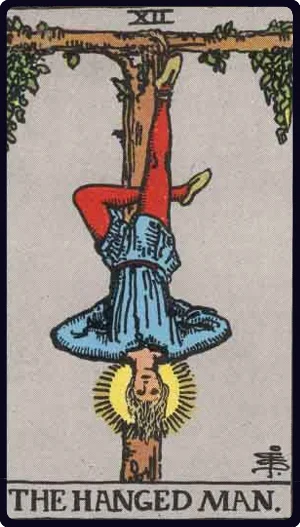
The figure is not being punished. He is hanging there on purpose, and his face is calm.
That detail carries the whole card. Rider-Waite-Smith could have drawn distress and drew serenity instead — a golden halo, a relaxed expression, one foot deliberately free. The Hanged Man is not stuck. He has stopped, which is a different thing, and the distinction is what most readings of this card get wrong.
What it describes in practice is the moment effort stops working. You have pushed at something — a project, a conversation, a decision — and every additional push produces less than the last one. The Hanged Man arrives at that exact point and says the problem is not the amount of force. The problem is the angle. And you cannot change your angle while you are still charging at the thing.
The uncomfortable part is that the pause has to be real. Not a strategic pause where you keep refreshing your inbox. Not a rest that is really surveillance. The card asks you to genuinely put the outcome down for a while, which feels like losing ground, and usually isn't — the insight that unlocks the situation almost never arrives while you are gripping it.
Sacrifice appears here too, but in a specific sense: giving up something real to gain something you cannot get any other way. Time, a position, a version of the plan you were attached to, the need to be the one who resolves it. The Hanged Man does not ask for suffering. It asks for an exchange — and it is worth checking, whenever this card shows up, whether what you are giving up is actually buying you anything.
The most common reversal is resistance. The pause has already arrived — the project stalled, the reply didn't come, the door shut — and you are refusing to accept it. So you push harder, send the follow-up, restructure the plan for the fourth time. Nothing moves, and the energy goes into the resistance rather than into the perspective shift the delay was offering.
The second reading is needless sacrifice. This one is quieter and more damaging. You are giving something up — time, standing, your own needs — under the belief that the giving up is noble, when in fact nobody asked for it and nobody benefits. Martyrdom without an audience. Where upright asks whether the exchange is buying you anything, reversed is the answer: it isn't.
In a more favourable position, the reversal simply means the suspension is ending. A long limbo breaks, the decision finally gets made, movement returns. Read the surrounding cards: beside The Chariot, Death, or an Ace, it is release. Beside The Devil, Eight of Swords, or a reversed court card, it is being stuck and calling it patience.
| Context | Upright | Reversed |
|---|---|---|
| General | A deliberate pause that produces a new angle | Resisting the pause; forcing what won't move |
| Love | Limbo; a decision nobody is making | Waiting on someone who isn't choosing you |
| Career | Projects on hold; time to reassess the plan | Stalled and refusing to accept it; burnout by effort |
| Money | Finances frozen; don't move funds yet | Sacrificing money for something that returns nothing |
| Health | Rest is the treatment, not an interruption to it | Ignoring the body's request to stop |
| Spirituality | Genuine surrender; insight through stillness | Spiritual bypassing; waiting instead of practising |
| Advice | Stop pushing. Change the angle. | Let it go, or admit you already have |
| Yes / No | Wait | No, or not on these terms |
The single hardest call with this card is whether the stillness you are in is The Hanged Man's productive suspension or plain stagnation. They feel identical from inside. They are not the same, and the tells are fairly reliable:
| Signal | A genuine pause | Stuck |
|---|---|---|
| Who chose it | You did, or you accepted it | It happened to you and you're still arguing with it |
| How it feels | Uncomfortable but quiet | Agitated; constant low-grade checking |
| Your attention | Has moved elsewhere | Still fixed on the same outcome |
| Is anything changing | Your view of the situation is | Nothing is, including your view |
| What you're doing | Something else entirely | Rehearsing the same conversation |
| The card reads as | Upright — let it finish | Reversed — this isn't patience |
If the right-hand column is describing you, the card is not asking for more waiting. It is asking you to notice that you never actually stopped.
If you are in a relationship, The Hanged Man describes limbo. Not conflict, not an ending — suspension. The relationship isn't moving forward and isn't breaking, usually because a decision exists that neither person wants to be the one to make. Often one partner is waiting for the other to force it, and both are calling that patience.
If you are single, the card frequently means a pause in dating that is doing more for you than another round of dates would. It also shows up around a person who is unavailable in a structural way — committed elsewhere, geographically distant, mid-crisis — where waiting has become the entire shape of the connection.
As a love outcome, The Hanged Man is honest and unpopular: nothing resolves on the current terms. The situation stays suspended until someone changes their view of it. Note the wording — changes their view, not waits longer. Additional patience applied to an unchanged perspective produces more of exactly what you have now.
As how someone feels about you: caught. There is real feeling, and there is something holding it in suspension — an obligation, a fear, an unfinished situation elsewhere. They are not indifferent, and they are also not about to act. Pressing for a decision here typically extends the limbo rather than ending it.
As their intentions: genuinely undecided. This card in an intentions position is one of the few that means what it appears to mean — no hidden plan, no strategy, just a person who has not resolved it and is letting time decide on their behalf.
Career. Things are on hold — an offer that hasn't landed, a decision made above you, a project frozen mid-flight. The card's read is that the delay is not a verdict on your work, and that this is a good moment to reassess the plan rather than defend it. Many people get their clearest career insight during exactly this kind of enforced gap, which is the card's argument in miniature.
It also appears for people carrying work that is invisible: the person who holds a team together without a title for it. The Hanged Man validates that the contribution is real, and quietly asks whether the arrangement is sustainable, or whether you've just got used to it.
Money. Funds are tied up, frozen, or committed somewhere you cannot access. The advice is to leave them there — this is not the moment to move money, restructure, or make a decisive financial call, because the information that would make it a good decision hasn't arrived. Where the card appears reversed, check for money going out to something that returns nothing, particularly money spent to keep another person comfortable.
The Hanged Man is a suspension card, so it delays rather than schedules. Where a spread demands a window, readers use these conventions:
| Method | Reading |
|---|---|
| Card number | 12 days, 12 weeks, or the 12th of the month |
| Element (Water) | Weeks rather than days; slow, indirect movement |
| Ruler (Neptune) | Long and imprecise; a season rather than a date |
| Cycle | Twelve months; a full year turning over |
| Practical reading | Nothing moves while you are still pushing it |
The last row is the one that actually matters. The Hanged Man's clock does not start until you stop — which is why this card so often produces the response "but it's been months." It has, and the months were spent waiting at the situation rather than genuinely away from it.
As a person, The Hanged Man describes someone patient, unhurried, and difficult to rush — a person who thinks in longer arcs than the people around them and is comfortable with unresolved things. Often quietly spiritual, often carrying an obligation that limits their availability. The shadow version uses patience as avoidance: endlessly considering, never choosing, and framing the indecision as depth.
As how someone sees you, they see you as unavailable or unreadable — not cold, but out of reach. Something about your situation, your timing, or your commitments makes you feel like a person they cannot quite get to, and they have adjusted their expectations accordingly.
As advice — the position this card is asked about most — the instruction is consistent and hard to follow: stop pushing, and change your angle instead. Don't send the follow-up. Don't force the decision. Don't fix it with more effort. Put it down properly, do something unrelated, and let the situation look different when you come back to it. The card is not recommending passivity; it is recommending that you stop applying force to the one variable you can't move.
The Hanged Man is card number 12, written XII. It sits between Justice (XI) and Death (XIII) — a sequence worth noticing: a judgement is passed, everything suspends, and then something ends. The Hanged Man is the held breath between a verdict and its consequence.
| Arabic number | 12 |
|---|---|
| Roman numeral | XII |
| Position in Major Arcana | 13th card (sequence starts at 0) |
| Numerological reduction | 1 + 2 = 3 → The Empress (III) |
| Element | Water |
| Ruling planet | Neptune ♆ |
| Hebrew letter | Mem (מ) — water |
| Preceding / following | XI Justice / XIII Death |
12 reduces to 3 (1+2), which is The Empress — and the pairing is more instructive than it first looks. The Empress is gestation: growth that happens on its own schedule and cannot be hurried by wanting it. The Hanged Man is the same principle experienced from the inside, where the waiting is uncomfortable and the growth is not yet visible. Same process, different vantage point.
The Hebrew letter Mem means water, which reinforces the elemental read: the card does not act, it dissolves. Neptune adds the spiritual dimension — surrender rather than defeat, and the specific quality of insight that arrives only when the ego stops steering.
Your own birth date reduces the same way, and Life Path 3 shares this card's underlying vibration. Calculate your Life Path number at Lumina Numbers ↗
This card is searched under more wrong names than any other in the deck, and one of them changes the meaning entirely.
The Hangman is worth correcting because it inverts the card. A hangman performs an execution; The Hanged Man is suspended by the ankle, alive, unharmed and calm. Nothing here is being killed. The card is about a state you are held in, not something being done to you — which is precisely why the figure's expression is peaceful rather than afraid.
The T-shaped frame he hangs from is not a gallows — it is a tree in leaf, still growing. The suspension is happening inside something alive. Whatever this pause belongs to has not stopped developing just because your part in it has.
Only the right ankle is tied. The left leg is bent and crossed behind it, entirely unrestrained. He could get down. He is choosing not to — and the crossed legs form a figure 4, the number of structure and stability, which is a quiet joke: the most stable thing in the image is the part everyone reads as trapped.
A golden nimbus surrounds his head, the traditional marker of illumination. The insight is not something he will receive later as a reward for waiting. It is present now, in the suspension — the position is the source of it.
The single most important detail in the card. Every other reading depends on it. Distress here would make this a card about victimhood; serenity makes it a card about choice, and the difference is the entire interpretation.
His arms are bent and hidden, forming an inverted triangle with his head — the water symbol, echoing the card's element. Hands out of sight also means hands out of use: this is not a card where you act.
Red trousers for the body and its drives, a blue tunic for calm and knowledge — the colour pairing traditionally used for saints. Yellow for the shoes, hair and halo: intellect, lit up at the top of an inverted body.
Several cards describe a stop. They describe very different stops, and mixing them up changes the advice completely:
| Card | What kind of stop | What to do |
|---|---|---|
| The Hanged Man (XII) | Chosen suspension; a perspective shift | Stop pushing; change the angle |
| Four of Swords | Recovery; rest after strain | Actually rest — this one is medical |
| Eight of Swords | Feeling trapped by a restriction you could leave | Look again; the bindings are loose |
| Two of Swords | Refusing to decide; avoidance | Take the blindfold off and choose |
| The Moon (XVIII) | Can't see clearly; information missing | Wait for facts, don't act on the feeling |
| Death (XIII) | Something is ending, not pausing | Let it go — it isn't coming back |
The most consequential confusion is with the Eight of Swords. The Hanged Man says the stillness is useful and should be allowed to finish; the Eight of Swords says the stillness is an illusion you can walk out of today. Opposite instructions, similar feeling.
The card beside The Hanged Man tells you what the pause is for — and whether it is nearly over:
See every pairing in the Combination Explorer — 484 Major Arcana combinations.
Card number 12, written XII. It sits between Justice (XI) and Death (XIII). In numerology 12 reduces to 3 (1+2), linking it to The Empress, card III.
A deliberate pause. Progress stops, but not as punishment — the halt is what makes a new perspective possible. It points to suspension, surrender, and seeing a familiar situation from an angle you could not reach while moving.
It reads as wait. The card doesn't refuse the outcome — it says the timing is wrong and that pushing now costs more than pausing. The answer often changes once the pause has done its work.
Limbo: no forward movement, no ending, and a decision nobody is making. As a love outcome it means the situation stays suspended until someone changes their view of it — not until someone waits longer.
Stop pushing and change your angle instead. Don't force the decision, don't chase the reply, don't fix it with more effort. Put it down properly and let it look different when you return.
Usually resisting a pause that has already arrived — stalling, forcing, spinning without progress. It can also mean needless self-sacrifice. In a favourable position it means a long suspension is finally ending.
Those are common misreadings. A hangman is an executioner, which inverts the card's meaning — the figure here is suspended by the ankle, alive and calm. Other legitimate names include The Hanged One, Le Pendu (French) and Der Gehängte (German).
It delays rather than schedules. Conventions include 12 days, 12 weeks, or the 12th of the month. Practically, the clock doesn't start until you stop pushing.
Water, ruled by Neptune, with the Hebrew letter Mem (which itself means water). Together they explain the card's surrender, dissolved control and spiritual perspective rather than action.
The Hanged Man is assigned a planet rather than a sign — Neptune, which rules Pisces. Readers who work with signs therefore associate it with Piscean qualities: dissolution, surrender and spiritual sensitivity.