Understand the difference
Justice vs Judgement: Fair Evaluation or a Changed Response?
Justice asks which facts, agreements and responsibilities should guide a fair evaluation. Judgement asks what you have learned from a wider review and how your next response will show it.
The names sound similar, and both cards can raise questions about accountability. Their difference is not a strict split between an external decision and an internal feeling. Justice can concern your own standards; Judgement can lead to an outward action. Compare the job the question asks you to do.
Compare the two questions
| Focus | Justice | Judgement |
|---|---|---|
| Main focus | Fair criteria, evidence and proportionate responsibility. | Review, recognition and a deliberate response to what you have learned. |
| Useful question | What would a fair assessment include? | What should I do differently after this review? |
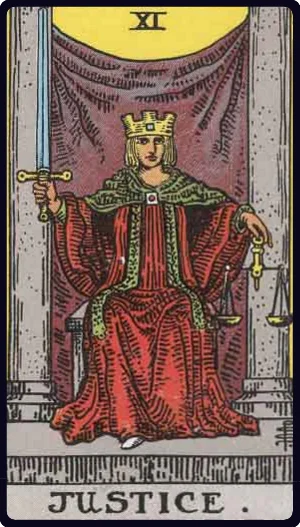
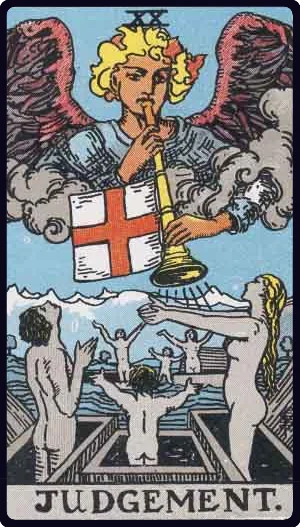
| Image cue | A seated figure holds scales and a sword. | Figures respond to a trumpet call. |
| Advice emphasis | Clarify agreements, examine facts and acknowledge consequences. | Translate reflection into a changed commitment or behaviour. |
| Easy mistake | Assuming a favourable legal result or automatic cosmic justice. | Assuming a destined reunion or that insight completes the work. |
Start with what is in the images
Justice
Justice holds a sword upright and a set of scales. The two objects offer a useful contrast between examining a matter and making a clear decision. Fairness still depends on relevant information, not on the appearance of the card.
Judgement
Judgement shows a trumpet above figures who raise their arms. The scene emphasises a response. In a modern reading, ask what recognition calls you to do rather than claiming that a supernatural instruction has been authenticated.
One situation, two advice cards
How should I respond after missing my part of a group deadline?
Your late contribution caused another volunteer to rush their work. The schedule was written down, but you underestimated the time needed. The group wants to finish the current project and avoid repeating the problem.
If Justice is Advice
With Justice in Advice, establish the facts and responsibilities. Acknowledge the agreed deadline, explain the impact accurately and discuss a proportionate way to put things right. Also check whether the schedule gave each person the information they needed. Fair assessment is neither automatic self-blame nor an excuse to shift all responsibility elsewhere.
If Judgement is Advice
With Judgement in the same Advice position, review the pattern and choose a changed response. Perhaps you repeatedly agree to work before checking your capacity. Name what you have learned and make the next commitment differently: confirm the scope, break it into stages and give an earlier warning if time becomes tight. An apology matters, but the lesson becomes visible through the next action.
If both themes apply
Justice can help you repair this specific agreement, while Judgement can help you change the way you enter future agreements. Those are related tasks with different evidence of completion.
How reversals change the question
Reversed Justice can invite a check on incomplete information, inconsistent standards or avoided responsibility. It does not prove that someone is corrupt or that a formal decision will go against you.
Reversed Judgement can invite a check on reluctance to respond, repetitive self-criticism or a lesson that has not reached your behaviour. Make the next change specific enough to try, instead of treating a harsh verdict about yourself as useful reflection.
Relationships and work
In a relationship reading
Justice can focus on a clear agreement, shared responsibilities or an imbalance that needs discussion. It does not decide who is the better person.
Judgement can focus on whether a familiar pattern has been understood and what a renewed commitment would require. It cannot establish that a former partner will return or that reconciliation is the right choice.
In a work reading
Justice may help you compare a brief, deadline or allocation against the actual agreement. Separate measurable responsibilities from assumptions about effort or intent.
Judgement may help you conduct a retrospective: what did the process teach you, and which change will you carry into the next project? A clear learning point needs an observable follow-through.
Common shortcuts to question
- Justice is punishment and Judgement is forgiveness.
Either card can support accountability and a constructive response. Neither grants permission to punish another person or promises that consequences disappear.
- Justice is always XI in every tarot deck.
Justice is XI in the Rider–Waite–Smith sequence used here. Other traditions can number Justice VIII. Judgement is XX in this deck.
Try the distinction yourself
Review a small agreement that did not work as planned. Write a fair assessment and a lesson as separate sentences.
Show two possible reading questions
Justice: What was agreed, what happened and what repair would be proportionate?
Judgement: What have I learned, and what will I change the next time I make this commitment?
Check that your assessment uses facts and your lesson names a behaviour. A label such as 'I am unreliable' does neither job well.
Questions about this comparison
Are Justice and Judgement the same tarot card?
No. Justice is XI and Judgement is XX in the Rider–Waite–Smith deck used here. Justice emphasises fair evaluation; Judgement emphasises review and a deliberate response.
Can Justice predict the result of a court case?
No. A symbolic reading cannot establish a legal outcome. Use the relevant facts and qualified advice for a real legal matter.
Does Judgement mean reconciliation with an ex?
It can support reflection on a past relationship, but it cannot predict another person's return or consent. Consider what has changed and whether renewed contact is appropriate.
Keep the individual cards in view
Justice in depth · Judgement in depth
To interpret both cards in one spread, read their combined meaning. This comparison explains their differences; the pair article explains how they can interact.
Explore all five comparisons · How to read two cards together
Images and interpretation
The pictured cards use Rider–Waite–Smith imagery by Pamela Colman Smith. Historical descriptions: A. E. Waite, The Pictorial Key to the Tarot, Part II and Part III. The distinctions, scenarios and exercises here are Lumina Tarot’s modern editorial interpretations. They are not quotations, universal rules or reports of consultations.