Pamela Colman Smith
Six of Wands Tarot Card Meaning
Receive recognition and share the credit
The Six of Wands draws attention to achievement being seen. It can invite you to acknowledge progress, present your work or consider how recognition is shared. The image raises a useful question: what deserves celebration, and what depends on the audience's approval?
Upright meaning
You may be ready to name an accomplishment clearly rather than dismissing it. Describe what changed, what you learned or what the work made possible. Recognition becomes more meaningful when it has something specific to recognise.
Visibility also creates responsibility. If people contributed to the result, acknowledge them; if you are being asked to represent the work, be clear about its limits. A successful moment can be enjoyed without treating it as proof that every next step will go well.
Reversed meaning
Reversed, the gap between effort and recognition may feel uncomfortable. Work can be useful while receiving little attention, and attention can arrive for work that is still incomplete. Separate the quality of the result from the size of the response.
The reversal can also invite a look at how credit is handled. Are you hiding a contribution, claiming too much of a shared result or relying on applause to decide whether to continue? Choose the interpretation that fits the evidence.
What to notice in the image
Start with what is pictured, then try the reading prompt. An image detail and an interpretation are different kinds of information.
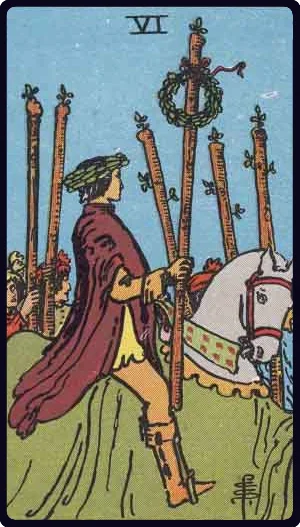
- Two laurel wreaths
The rider wears a wreath and carries a staff with another wreath near its top.
Reading prompt: Recognition has been made visible. What achievement can you describe without exaggerating it?
- The accompanying group
Other people and upright staffs appear alongside the horse.
Reading prompt: A central figure is not necessarily working alone. Who supported the result or needs to be included in its recognition?
Love and relationships
Upright
The Six can encourage open appreciation: tell someone what you value in their contribution and let them recognise yours. In a relationship, public attention is only one form of support; ordinary acts of acknowledgement matter too.
Reversed
Consider whether approval has become a test one person cannot stop taking. Ask for appreciation directly and specifically. Posting a happy image or receiving compliments from others cannot settle a private disagreement by itself.
Work and practical resources
Upright
Prepare a clear account of a completed result for a review, portfolio or team update. Include the evidence and the contributors. The card can help you approach visibility deliberately, rather than waiting for someone to notice work they may not have seen.
Reversed
If good work is overlooked, check where and how it was communicated. If feedback is critical, separate useful points from a general feeling of rejection. Neither silence nor praise replaces examining the result itself.
Time, attention and materials
Keep a simple record of finished work and its effect. This gives you a basis for discussing progress without turning every activity into a search for more attention.
A worked reading
Question: How can I present our group's successful exhibition fairly?
You are invited to speak about an exhibition that many volunteers helped organise. The Six appears as Advice.
Use the visible rider as a prompt to speak clearly about what the group achieved, and the surrounding figures as a reminder of the shared work. Show one concrete result, name the contributors and explain what you would improve next time. You can accept the invitation confidently while making the recognition accurate and generous.
Change the position
As a Situation, the Six might describe attention already arriving. As an Obstacle, it could highlight choosing what looks impressive over what the project actually needs.
Distinguish this card from nearby themes
Six of Wands and Four of Wands
The Four emphasises a shared place or occasion. The Six emphasises a result being recognised. A quiet celebration with friends and a public presentation can mark the same work in different ways.
Compare: Four of Wands
Six of Wands and Seven of Wands
The Six concerns being seen and acknowledged. The Seven concerns maintaining a position under pressure. Receiving attention does not automatically mean you need to defend yourself against it.
Compare: Seven of Wands
Take the reading into practice
Reflect: What would I count as meaningful progress even if nobody applauded it?
Try: Write an honest three-sentence account of one result: what happened, who helped and what comes next.
Frequently asked questions
Does the Six of Wands guarantee that I will win?
No. Victory is part of the image's traditional vocabulary, but the card does not provide reliable odds. It can prompt you to prepare, recognise progress or think about how you would handle visibility.
Is a reversed Six of Wands a sign of failure?
It can be read around delayed recognition, discomfort with visibility or dependence on approval. Those themes do not establish that the underlying work has failed; assess the result directly.
Read within the suit
Wands use Fire as a symbolic element in this guide. Initiative, effort and how an undertaking develops. The individual image gives the reading its focus; a rank or an element does not set a calendar date.
Use a physical deck or choose a card from the Wands list to practise. The site’s Daily Draw, Three-Card Spread and Yes/No Oracle use only the 22 Major Arcana, so this Minor card is not an available draw result.
Sources and interpretation
Historical image descriptions: A. E. Waite, The Pictorial Key to the Tarot, Part III, section 2, the suit of Wands.
The observations refer to the card displayed above. The practical readings, comparison prompts and worked scenario are Lumina Tarot’s modern editorial interpretations. They do not reproduce every historical meaning, and reversal conventions vary. See our approach and correction process.