Pamela Colman Smith
Four of Wands Tarot Card Meaning
Make room to share a milestone
The Four of Wands brings attention to a place or moment people can share: a welcome, a milestone, a reunion or work completed together. Its central question is how to recognise what has been built and let people participate in it.
Upright meaning
A milestone gives a continuing process a place to pause. You might mark finishing a difficult stage, acknowledge people who helped or make a space feel more welcoming. Celebration can be small and still give the achievement a clear shape.
The card also asks what supports belonging. A gathering is more than its decoration: who is invited, who feels comfortable and who quietly makes it possible? A stable shared space depends on those practical details.
Reversed meaning
Reversed, a milestone may feel private, postponed or less comfortable than its outward appearance suggests. You could be relieved about an achievement without wanting a public celebration. That does not make the achievement less real.
Alternatively, there may be a mismatch between the welcoming image and the experience of people involved. Check the arrangements before assuming harmony. A useful response might be a quieter format, clearer responsibilities or an invitation that had been overlooked.
What to notice in the image
Start with what is pictured, then try the reading prompt. An image detail and an interpretation are different kinds of information.
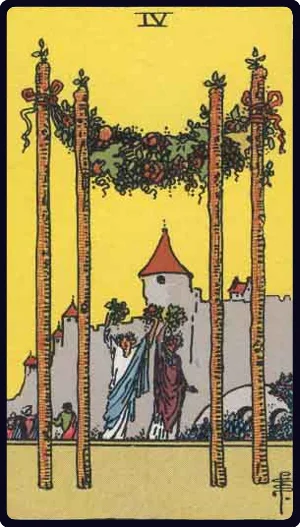
- The garland across four staffs
Leafy decoration hangs between upright wands in the foreground.
Reading prompt: A temporary frame can make a moment feel special. What would help you mark a stage without treating it as the end of every task?
- People and a shared place
Two figures hold flowers near a large building, with more people visible around them.
Reading prompt: Belonging involves participation. Whose contribution or comfort needs attention?
Love and relationships
Upright
The Four can focus on the everyday conditions that help a relationship feel welcoming: shared space, time with friends or marking a step you both chose. It can accompany a celebration in your question, but the card does not independently identify an engagement or wedding.
Reversed
A public milestone may not reflect how both people feel privately. Discuss what the occasion means and what would make it comfortable. You do not have to perform happiness in a particular format to value the connection.
Work and practical resources
Upright
A team may benefit from recognising a completed stage before rushing into the next one. Name the work, thank the contributors and record what made collaboration possible. This makes the pause useful as well as pleasant.
Reversed
Look for people missing from the recognition or practical work hidden beneath the celebration. A launch party does not resolve unclear ownership, and praise means more when it includes the less visible contributions.
Time, attention and materials
Choose a form of celebration that fits the people and space available. A shared meal, a short thank-you note or time to rest may suit the milestone better than an elaborate event.
A worked reading
Question: How should we mark reopening our shared studio?
Volunteers have finished repairing a room, but the same two people are organising every detail of the opening. The Four appears as Advice.
Read the garland as an invitation to mark the achievement, and the group as a reminder to share the work of welcoming people. Agree on a simple event, divide the remaining tasks and acknowledge everyone who contributed. Check that the room is usable for the people invited. The milestone becomes a shared experience rather than another burden for the organisers.
Change the position
As a Situation, the Four could describe a supportive setting already available. As an Obstacle, it could ask whether keeping up an image of harmony is preventing an honest conversation about the arrangements.
Distinguish this card from nearby themes
Four of Wands and Six of Wands
The Four centres a shared occasion and a place of welcome. The Six centres visible recognition of an achievement. Ask whether the reading concerns belonging together or how accomplishment is seen.
Compare: Six of Wands
Four of Wands and Three of Wands
The Three looks toward responses and the next horizon. The Four offers a pause to recognise what is here. Looking outward and appreciating a present milestone can support each other.
Compare: Three of Wands
Take the reading into practice
Reflect: What deserves recognition, and who helped make it possible?
Try: Choose one fitting way to mark the milestone and include the people whose work made it happen.
Frequently asked questions
Does the Four of Wands always mean marriage?
A wedding is one possible context for a shared celebration. The card can equally relate to a reunion, a welcoming home or a completed group project. Use the question to decide which context is relevant.
Does the reversed Four of Wands mean a celebration will fail?
No. This guide reads it around a private milestone, postponement or an issue with belonging. Reversal conventions differ; Waite's historical entry even retains a positive meaning for this card when reversed.
Read within the suit
Wands use Fire as a symbolic element in this guide. Initiative, effort and how an undertaking develops. The individual image gives the reading its focus; a rank or an element does not set a calendar date.
Use a physical deck or choose a card from the Wands list to practise. The site’s Daily Draw, Three-Card Spread and Yes/No Oracle use only the 22 Major Arcana, so this Minor card is not an available draw result.
Sources and interpretation
Historical image descriptions: A. E. Waite, The Pictorial Key to the Tarot, Part III, section 2, the suit of Wands.
The observations refer to the card displayed above. The practical readings, comparison prompts and worked scenario are Lumina Tarot’s modern editorial interpretations. They do not reproduce every historical meaning, and reversal conventions vary. See our approach and correction process.