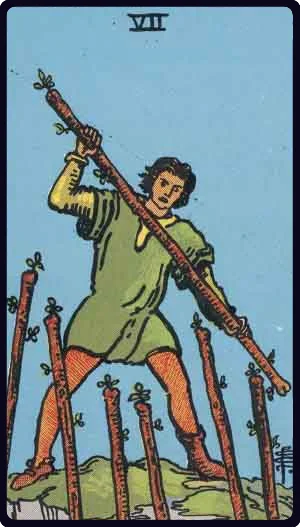
Pamela Colman Smith
Seven of Wands Tarot Card Meaning
Decide what is worth defending
The Seven of Wands brings one position into focus under pressure. That position might be a boundary, an idea or a commitment. Its useful challenge is to distinguish what needs a clear defence from what could benefit from discussion or revision.
Upright meaning
You may need to state where you stand and explain why. A boundary works best when it names what you can do, what you cannot do and what alternative is available. Repeating that boundary can be appropriate without turning the exchange into a fight.
Conviction and openness can coexist. If a challenge reveals a genuine weakness in your plan, changing that part is not the same as abandoning everything. Ask what you are protecting: a useful principle, a practical limit or simply the wish to be right.
Reversed meaning
Reversed, defending a position may be consuming more energy than it deserves, or pressure may be making it difficult to state a legitimate limit. Look at the actual demand and your capacity before deciding whether to hold, revise or leave the position.
The reversal can also suggest defensiveness becoming automatic. A question is not always an attack. Try to identify the specific behaviour that needs a boundary instead of responding to every disagreement as the same threat.
What to notice in the image
Start with what is pictured, then try the reading prompt. An image detail and an interpretation are different kinds of information.
- Raised ground
The figure's feet are on ground above the lower ends of the other staffs.
Reading prompt: Consider what supports your position: preparation, experience or a clear agreement. An advantage in an image does not prove you are right.
- Six staffs from below
Six wands enter the scene from the lower edge; their holders are not shown.
Reading prompt: Pressure can be visible while its source remains unclear. What do you know about the demand, and what are you assuming?
Love and relationships
Upright
The Seven can support a clear conversation about personal space, time or involvement from others. A shared boundary needs both people's agreement. Protecting a connection should not mean controlling someone else's friendships or choices.
Reversed
You may be defending every preference or giving up a need to keep the peace. Choose one concrete example and explain its effect. A workable boundary describes your own participation rather than trying to dictate the other person's feelings.
Work and practical resources
Upright
Use the card to clarify scope when extra requests arrive. State what can be delivered under the current agreement and what would need to change. An evidence-based explanation is often more useful than a general refusal or a long defence of your competence.
Reversed
Review whether you are protecting essential quality or holding every detail too tightly. If the workload is unreasonable, make the constraint visible; if a suggestion is useful, you can accept it without losing ownership of the work.
Time, attention and materials
Treat attention as a limited resource. Decide which requests need a response, which can wait and which fall outside the task you agreed to take on.
A worked reading
Question: How should I respond to another last-minute change?
You agreed to make a simple event handout. The organiser now wants several extra pages without changing the deadline. The Seven appears as Advice.
Define the ground you are holding: a readable handout finished on time. Offer two workable options, such as keeping the original scope or replacing an existing section with the new material. Explain what additional work would require. The reading becomes a clear discussion of limits rather than an assumption that the organiser is an enemy.
Change the position
As a Situation, the Seven may describe a real contest over scope or expectations. As an Obstacle, it can ask whether defending your original plan is preventing you from hearing a useful alternative.
Distinguish this card from nearby themes
Seven of Wands and Nine of Wands
The Seven faces pressure in the immediate scene. The Nine looks guarded after prior strain. Ask whether you need to respond to a current request or restore capacity after what has already happened.
Compare: Nine of Wands
Seven of Wands and Five of Wands
The Five can describe several approaches colliding without a shared rule. The Seven focuses on one position being maintained. Clarifying a group process may solve a Five problem that a personal defence would only intensify.
Compare: Five of Wands
Take the reading into practice
Reflect: What exactly am I protecting, and what would a reasonable compromise preserve?
Try: Write a boundary as a practical sentence: I can do this within the current arrangement; that change would require this adjustment.
Frequently asked questions
Does the Seven of Wands mean I should never back down?
No. It invites you to examine what is worth defending and why. Revising a weak argument, accepting useful feedback or leaving an unproductive dispute can be a considered response.
Does this card prove I have enemies?
No. The image contains pressure and an unseen source, but it cannot identify real people or motives. Use observable behaviour and direct communication to understand the situation.
Read within the suit
Wands use Fire as a symbolic element in this guide. Initiative, effort and how an undertaking develops. The individual image gives the reading its focus; a rank or an element does not set a calendar date.
Use a physical deck or choose a card from the Wands list to practise. The site’s Daily Draw, Three-Card Spread and Yes/No Oracle use only the 22 Major Arcana, so this Minor card is not an available draw result.
Sources and interpretation
Historical image descriptions: A. E. Waite, The Pictorial Key to the Tarot, Part III, section 2, the suit of Wands.
The observations refer to the card displayed above. The practical readings, comparison prompts and worked scenario are Lumina Tarot’s modern editorial interpretations. They do not reproduce every historical meaning, and reversal conventions vary. See our approach and correction process.