Pamela Colman Smith
Seven of Swords Tarot Card Meaning
Check the method as carefully as the goal
The Seven of Swords examines indirect methods, selective disclosure and the limits of working alone. A quiet strategy can be reasonable, but concealment can also undermine consent or trust. Judge the actual method and its consequences rather than using the card to declare someone dishonest.
Upright meaning
Ask who needs which information to make a fair decision. Privacy about your own unfinished idea differs from withholding facts that affect another person’s participation.
Consider whether a shortcut transfers work or risk to someone else. A clever approach is more useful when you can explain how it respects the agreement.
Reversed meaning
Reversed, you may need to clarify an omission, revisit a shortcut or ask for help after trying to handle everything alone.
It can also describe choosing more direct communication. Share the information relevant to the decision without feeling obliged to disclose every private detail.
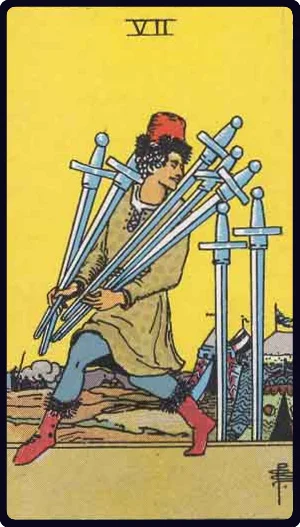
What to notice in the image
Start with what is pictured, then try the reading prompt. An image detail and an interpretation are different kinds of information.
- Five carried, two left
The figure carries five swords while two remain standing.
Reading prompt: What has your plan accounted for, and what is being left unresolved?
- Backward glance
The figure looks back towards the camp.
Reading prompt: Would the method remain acceptable if the affected people understood it?
Love and relationships
Upright
Discuss privacy and expectations directly. The card cannot establish cheating, secret contact or another person’s intention.
Reversed
If something important was omitted, state it clearly and allow the other person to reconsider. An explanation does not remove their right to a different choice.
Work and practical resources
Upright
Before using a shortcut, check ownership, permissions and dependencies. Quiet preparation is useful when it does not bypass people who need to decide.
Reversed
Correct incomplete information promptly. Explain what changes for colleagues rather than presenting the correction as a purely personal confession.
Time, attention and materials
Count hidden costs such as duplicated effort or missing documentation. Saving time today may create a larger handover problem.
A worked reading
Question: Can I simplify our shared project without telling everyone?
You want to remove a difficult section from a group presentation and hope nobody will notice. The Seven appears as Obstacle.
The shortcut may affect material another person is preparing. Describe the proposed change, explain the time constraint and ask the group to choose the reduced scope. A strategic simplification can remain useful once it becomes an explicit agreement. The reading examines your available method rather than accusing another member of secrecy.
Change the position
As Advice, consider a thoughtful strategy and appropriate privacy. As Situation, check what information or responsibility has been unevenly distributed.
Distinguish this card from nearby themes
Seven of Swords and Five of Swords
The Five centres the cost of an open contest. The Seven centres the method used around an issue, including avoidance or selective disclosure.
Compare: Five of Swords
Seven of Swords and Page of Swords
The Page asks careful questions to learn. The Seven asks how information is being used, withheld or acted upon.
Compare: Page of Swords
Take the reading into practice
Reflect: Who needs to understand this plan before it affects them?
Try: Identify one omitted detail that matters to a shared decision and communicate it clearly.
Frequently asked questions
Does this card prove someone is lying?
No. A symbolic image is not evidence about another person. Look for specific inconsistencies and ask relevant questions without treating suspicion as proof.
Is every private plan dishonest?
No. You may keep personal work private. The practical distinction is whether others need the information for an informed decision or shared responsibility.
Read within the suit
Swords use Air as a symbolic element in this guide. Thought, communication, decisions and conflict. The individual image gives the reading its focus; a rank or an element does not set a calendar date.
Use a physical deck or choose a card from the Swords list to practise. The site’s Daily Draw, Three-Card Spread and Yes/No Oracle use only the 22 Major Arcana, so this Minor card is not an available draw result.
Sources and interpretation
Historical image descriptions: A. E. Waite, The Pictorial Key to the Tarot, Part III, section 2, the suit of Swords.
The observations refer to the card displayed above. The practical readings, comparison prompts and worked scenario are Lumina Tarot’s modern editorial interpretations. They do not reproduce every historical meaning, and reversal conventions vary. See our approach and correction process.