Pamela Colman Smith
Five of Swords Tarot Card Meaning
Examine the cost of winning an argument
The Five of Swords asks what a conflict leaves behind. Being able to claim victory does not tell you whether the outcome was useful or fair. Consider the disputed issue, the way people were treated and whether further engagement would improve anything.
Upright meaning
Separate achieving your purpose from defeating someone. A forceful argument may settle a point while damaging the cooperation needed afterwards.
Sometimes the useful response is to leave an unproductive exchange. Choose your boundary according to actual conduct and available support, not a need to deliver the last word.
Reversed meaning
Reversed, there may be an opening for repair or a tendency to keep replaying the contest. Look for actions that distinguish the two.
A calmer atmosphere does not automatically mean the issue was resolved. Clarify what agreement, acknowledgment or limit would prevent a repeat.
What to notice in the image
Start with what is pictured, then try the reading prompt. An image detail and an interpretation are different kinds of information.
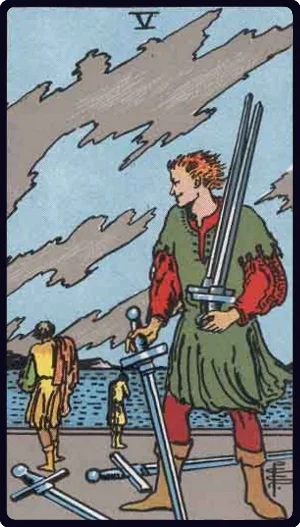
- Collected swords
The foreground figure holds three swords while two remain on the ground.
Reading prompt: What was gained, and what did the method cost?
- Departing figures
Two people turn away towards the water.
Reading prompt: Who still needs a voice in the outcome?
Love and relationships
Upright
Avoid turning a disagreement into a test of who cares more. Discuss the particular behaviour and leave room for a clear boundary.
Reversed
An offer to start over needs a practical change in how disagreement is handled. Reconciliation is a choice, not a duty imposed by the card.
Work and practical resources
Upright
Competitive discussion can discourage people from contributing useful information. Ask whether the meeting process rewards the best answer or the strongest interruption.
Reversed
If a dispute has settled, document the working agreement and check that people affected understand it. Silence alone is not agreement.
Time, attention and materials
Notice how much time a recurring argument consumes. Set a scope for discussion and a point at which another process is needed.
A worked reading
Question: How can we repair a planning meeting that became personal?
You persuaded a club to use your proposal, but dismissed another member in front of everyone. The Five appears as Situation.
The chosen proposal and the way you argued for it are separate matters. Acknowledge the dismissive remark specifically and invite the overlooked practical concern back into the plan. Keeping the proposal does not prevent taking responsibility for the exchange. The card does not tell you what the other member now thinks.
Change the position
As Advice, examine the cost before continuing a contest. As Obstacle, the need to win may be preventing a workable compromise.
Distinguish this card from nearby themes
Five of Swords and Five of Wands
The Five of Wands can highlight competing efforts. The Five of Swords brings attention to the aftermath and interpersonal cost of conflict.
Compare: Five of Wands
Five of Swords and Seven of Swords
The Seven examines indirect methods and disclosure. The Five examines what happens when a contest produces winners and losers.
Compare: Seven of Swords
Take the reading into practice
Reflect: What outcome would be useful even if nobody could call it a victory?
Try: Rewrite the disputed goal without using words about beating, proving or defeating another person.
Frequently asked questions
Does this card identify an enemy?
No. It can prompt scrutiny of a conflict without identifying anyone as malicious. Describe observable behaviour before drawing conclusions.
Should I always walk away?
No. Consider the issue, whether discussion remains useful and what alternatives exist. Sometimes a clear correction or an agreed process is more appropriate.
Read within the suit
Swords use Air as a symbolic element in this guide. Thought, communication, decisions and conflict. The individual image gives the reading its focus; a rank or an element does not set a calendar date.
Use a physical deck or choose a card from the Swords list to practise. The site’s Daily Draw, Three-Card Spread and Yes/No Oracle use only the 22 Major Arcana, so this Minor card is not an available draw result.
Sources and interpretation
Historical image descriptions: A. E. Waite, The Pictorial Key to the Tarot, Part III, section 2, the suit of Swords.
The observations refer to the card displayed above. The practical readings, comparison prompts and worked scenario are Lumina Tarot’s modern editorial interpretations. They do not reproduce every historical meaning, and reversal conventions vary. See our approach and correction process.