Pamela Colman Smith
Death Tarot Card Meaning
Identify what is ending and give the transition practical attention.
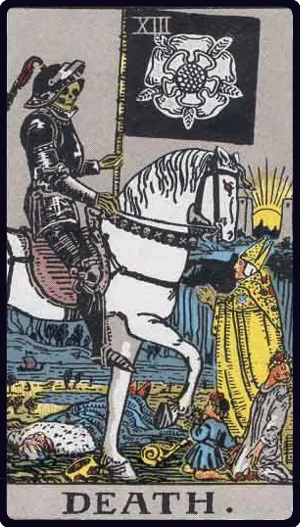
Death can bring endings, transition and the limits of preserving an old arrangement into focus. In this site’s reflective approach, the card asks what is actually changing and what closure it needs. The dramatic image does not establish a physical death or announce that harm will occur.
Upright meaning
Death can symbolise an ending, transition or change in an established pattern. Identify what is actually finishing and what practical closure it needs. The image does not predict a physical death, and it does not mean you must abruptly abandon something important.
An ending can be specific: a role, method, expectation or stage of a project. Name that boundary before extending the interpretation to every part of life. Practical closure might mean handing over materials, acknowledging a changed agreement or stopping work that no longer serves its purpose. The card does not decide that an ending is necessary; it prompts you to examine one.
Reversed meaning
Consider whether an ending is being resisted, a transition is incomplete or you need more time to adjust. Name the specific change rather than treating the whole future as uncertain. A gradual transition may be possible.
You may be holding on to an arrangement whose purpose has changed, or trying to force closure before the remaining responsibilities are understood. Those possibilities need different responses. Look for the task, conversation or unresolved expectation that makes the transition difficult, rather than treating discomfort as proof that you must act immediately.
What to notice in the image
The first description names a visible detail. The reading prompt offers one way to interpret it in context.
- The rider and white horse
An armoured skeleton sits on a pale horse moving across a scene with several human figures.
Reading prompt: Ask which transition affects the arrangement as a whole and which different responses it brings from the people involved.
- The flower on the banner
A white flower appears on the dark banner carried by the rider.
Reading prompt: What can be carried forward from an ending without preserving the entire form that held it?
- The light at the horizon
Yellow light appears in the distance beyond the foreground figures.
Reading prompt: Consider what might remain possible after closure while leaving the actual next stage open to experience.
Love and relationships
Upright
Discuss whether an old way of relating still works. A change may involve a new agreement, practical closure or an ending chosen by the people involved.
Reversed
Identify what remains unresolved and which part you can address. The card cannot promise that an ex will return or decide the relationship for you.
The card does not order a breakup. A relationship may be changing a routine, a role or an expectation rather than ending altogether. If a relationship has ended in real life, the reading can focus on practical closure and support. It cannot tell you that another person will return transformed or that you should wait for that outcome.
Work, money and practical resources
Work — upright
Review what should be completed, handed over or retired before starting the next phase. Preserve the lessons worth carrying forward.
Work — reversed
A project may be continuing out of habit after its purpose has changed. Check the evidence before choosing whether to revise or conclude it.
Money and resources
Review commitments associated with a phase that is ending. The card cannot predict a financial loss or tell you to make a particular transaction.
A worked reading
Question: How can I step out of a volunteer role that no longer fits my available time?
Use Death to define the transition clearly. Decide which responsibility you are leaving, communicate the change and list the information the next person needs. Agree a final handover point instead of remaining indefinitely available for every task. You may still value the group without continuing in the same role. If the card is reversed, examine whether the difficulty is an unfinished handover, a fear of disappointing others or an assumption that leaving one role means losing every connection to the community.
Change the position, change the question
In Situation, identify the ending or transition that is already supported by the facts. In Action, attend to closure. In Consider, ask what remains unfinished and what can continue in a different form.
Death and The Tower
Death can focus on the transition from one form or stage to another. The Tower can focus on a disruption that exposes a weak assumption or arrangement. An ending may be gradual and carefully managed; a challenged assumption may not require ending the whole project. Distinguish what is changing before choosing the response.
Death in a two-card reading
These pair readings include worked examples and explain how named positions can change the emphasis.
- The Hermit + DeathGiving an ending enough space to be understood
- The Fool + DeathMake room for a beginning by acknowledging an ending
- The Magician + DeathCarry useful skills into a changed arrangement
- The High Priestess + DeathAcknowledge a transition before explaining every feeling about it
Choose two cards in the Combination Explorer · How to read a pair
Number and correspondences
- Printed card number
- XIII · 13
- Element used here
- Water
- Symbolic correspondence used here
- Scorpio
Death is not a direct result in this site’s birth-card calculator. The printed card number does not mean that a person has a matching Life Path or that a date determines their personality.
Correspondences offer an optional interpretive convention; they do not set a date for an event. See the element table and birth-card method for the rules this site uses.
Frequently asked questions
Does drawing Death mean that someone will die?
No. A tarot draw cannot establish that a physical death or injury will occur. Here the card is used to reflect on endings, changed roles and practical transition. Return to the actual question and observable circumstances rather than treating the image as a warning of an event.
Is Death a yes or no card?
In this site’s Yes/No Oracle, Death upright is assigned Maybe. The interpretation depends on what is being changed or concluded. The card does not provide a universal no to every question. Every reversed card is assigned Maybe. These are the tool’s editorial conventions, not a universal tarot rule or verified odds.
Can Death tell me when something will happen?
Death does not set a change for Scorpio season or a particular month. A real transition has its own obligations, dependencies and dates. Identify the practical steps of closure instead of deriving a deadline from the card.
Take the reading into practice
What is actually ending, and what practical closure does it need?
Try: Name one ending task and the information or conversation needed to complete it.
Sources and interpretation
Historical reference: A. E. Waite, The Pictorial Key to the Tarot, Part II.
The image observations above refer to the card shown on this page. The practical meanings, comparisons and worked example are Lumina Tarot’s editorial interpretations, not quotations from the historical text or verified predictions. Read our approach and correction process.