Pamela Colman Smith
Ten of Swords Tarot Card Meaning
Recognise a limit and decide what needs to stop
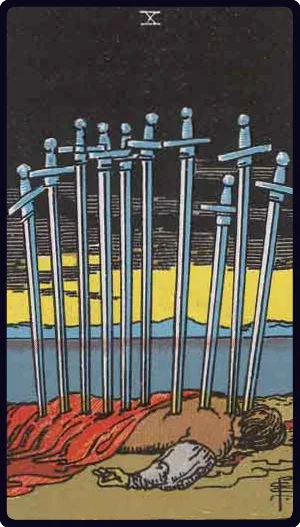
The Ten of Swords uses an extreme image to explore a limit, an ending or the point at which an approach can no longer be sustained. It is not a prediction of injury or physical death. Focus on what has actually ended and what practical care the aftermath requires.
Upright meaning
Acknowledge when a plan is no longer workable under its current conditions. Continuing to argue with that fact may consume resources needed elsewhere.
An ending does not define your entire ability or future. Separate the specific project, arrangement or expectation from a judgement about your whole life.
Reversed meaning
Reversed, you may be beginning to respond after an ending or struggling to accept that an approach has reached its limit. Look for concrete circumstances.
Do not force a recovery story before you are ready. A modest next arrangement can be useful without making the past experience seem necessary or beneficial.
What to notice in the image
Start with what is pictured, then try the reading prompt. An image detail and an interpretation are different kinds of information.
- Prone figure
Ten swords appear along the back of a figure lying on the ground.
Reading prompt: What approach has reached a limit that needs acknowledgment?
- Distant light
A bright band lies between the dark sky and distant land.
Reading prompt: What small possibility can be investigated without demanding a complete new plan?
Love and relationships
Upright
If a conversation or arrangement has ended, respect the expressed boundary. The image cannot tell you that every relationship problem requires separation.
Reversed
Check whether renewed contact is welcome and whether conditions have changed. Wanting relief from an ending is not the same as having a mutual plan to restart.
Work and practical resources
Upright
When a project is cancelled, identify closure tasks: notify contributors, preserve useful work and stop unnecessary commitments.
Reversed
A restart needs a changed condition, not simply more determination. Ask what new resource, scope or agreement would make this attempt different.
Time, attention and materials
Stop spending effort on a version that has been explicitly closed. Reuse what is useful where permissions and circumstances allow.
A worked reading
Question: How do I respond when our event is cancelled after months of preparation?
The venue becomes unavailable and the group decides the event cannot proceed. The Ten appears as Situation.
Confirm the cancellation message, contact participants and organise the return or storage of materials. Keep a record of reusable planning work. The card gives language to a disappointing ending; it does not declare the effort worthless or guarantee that a replacement event will succeed.
Change the position
As Advice, name the limit and complete necessary closure. As Obstacle, a sweeping conclusion such as “nothing I do works” may be extending one ending into an identity.
Distinguish this card from nearby themes
Ten of Swords and Three of Swords
The Three centres the hurt of disappointment. The Ten asks whether a particular approach or arrangement has reached an endpoint.
Compare: Three of Swords
Ten of Swords and Ten of Wands
The Ten of Wands carries an excessive load that may be redistributed. The Ten of Swords asks whether the present approach needs to end or change fundamentally.
Compare: Ten of Wands
Take the reading into practice
Reflect: What has specifically ended, and what still needs a practical response?
Try: Make two short lists: closure tasks and useful things that can be carried forward.
Frequently asked questions
Does this card predict physical harm?
No. This guide uses the scene symbolically to examine limits and endings. A card cannot establish that an injury or death will occur.
Is everything over when the Ten appears?
No. Define the scope of the question. One ended arrangement does not settle what remains possible in every other part of life.
Read within the suit
Swords use Air as a symbolic element in this guide. Thought, communication, decisions and conflict. The individual image gives the reading its focus; a rank or an element does not set a calendar date.
Use a physical deck or choose a card from the Swords list to practise. The site’s Daily Draw, Three-Card Spread and Yes/No Oracle use only the 22 Major Arcana, so this Minor card is not an available draw result.
Sources and interpretation
Historical image descriptions: A. E. Waite, The Pictorial Key to the Tarot, Part III, section 2, the suit of Swords.
The observations refer to the card displayed above. The practical readings, comparison prompts and worked scenario are Lumina Tarot’s modern editorial interpretations. They do not reproduce every historical meaning, and reversal conventions vary. See our approach and correction process.