Pamela Colman Smith
Ten of Wands Tarot Card Meaning
Change how the load is carried
The Ten of Wands makes the weight of responsibility visible. Many individually reasonable tasks can become difficult when one person carries them together. Ask what needs to be completed, what can be shared and what no longer needs to be carried at all.
Upright meaning
The load may come from worthwhile commitments rather than a mistake. A growing project, a shared household or a successful event can all create more ongoing work than expected. Acknowledge the amount of work before looking for a better arrangement.
The card's question is about distribution as much as effort. Working harder may get you through a short phase, but it does not explain how the same demands will be handled next time. Identify which responsibilities truly require your involvement.
Reversed meaning
Reversed, the load may be ready to come down: through a handover, a reduced scope or the decision to stop an unnecessary task. Relief is more likely to last when the new arrangement is explicit.
Another reading is a load that has become difficult to acknowledge. If you keep saying everything is fine while tasks are slipping, make the work visible. Asking for help becomes more practical when you can name the task, the effort it needs and who could own it.
What to notice in the image
Start with what is pictured, then try the reading prompt. An image detail and an interpretation are different kinds of information.
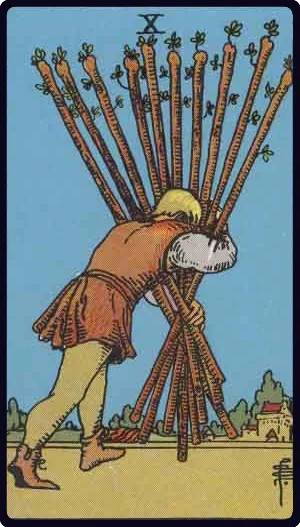
- The bundled wands
The figure holds all ten staffs together in front of the body.
Reading prompt: Separate the bundle into individual responsibilities. Which have been grouped together only because you usually do them?
- The bent posture and distant buildings
The person bends forward, and the staffs partly obstruct the view toward the buildings.
Reading prompt: A heavy workload can make it harder to see priorities. What needs attention first, and what destination is the work serving?
Love and relationships
Upright
The Ten can prompt an honest account of shared and invisible responsibilities: planning, arranging, remembering and following up. A relationship may benefit from dividing ownership of tasks, not just asking one person to help the other occasionally.
Reversed
If responsibilities are being redistributed, check that the handover is complete. A person may still carry the planning and reminders even after someone else starts doing the visible step. Agree on what taking ownership includes.
Work and practical resources
Upright
Make the full workload visible before accepting another commitment. Separate essential work from extras and discuss priorities with whoever depends on the result. A clear limit can protect the work you have already promised to finish.
Reversed
Delegation can stall when instructions, access or decision-making authority are missing. Give the next person enough context to own the task, then agree on a proportionate check-in rather than supervising every detail.
Time, attention and materials
Count the recurring tasks as well as the large one-off jobs. Small obligations can occupy a substantial part of the week when nobody has recorded them together.
A worked reading
Question: Why does organising our hobby group feel like a second job?
You arrange the room, answer messages, bring materials and remind everyone about dates. Members are willing to help but do not know the full list. The Ten appears as the Situation.
Unbundle the work into booking, communication, materials and hosting. Ask members to take ongoing ownership of separate parts, with access to the information they need. Drop an optional activity if nobody can support it. This addresses the structure of the load instead of waiting for others to notice how tired the organiser has become.
Change the position
As Advice, the Ten can ask you to inventory responsibilities before changing them. As an Obstacle, it may describe believing that doing everything yourself is the only way to ensure it is done properly.
Distinguish this card from nearby themes
Ten of Wands and Nine of Wands
The Nine is alert after prior strain; the Ten is burdened by the current load. Rest can matter in both, but the Ten especially asks whether the work itself needs to be reduced or redistributed.
Compare: Nine of Wands
Ten of Wands and King of Wands
The King can be read as directing an undertaking. The Ten shows one person physically carrying its demands. Leadership becomes more sustainable when direction does not require doing every task yourself.
Compare: King of Wands
Take the reading into practice
Reflect: Which task stays mine only because nobody has discussed another arrangement?
Try: List the current responsibilities and mark each keep, share, postpone or stop. Discuss one concrete change with the people affected.
Frequently asked questions
Does the Ten of Wands mean my relationship should end?
The card can highlight an unequal or exhausting workload, but it does not decide the relationship's future. Examine the specific responsibilities, discuss what can change and make your own decision using the real circumstances.
Is the Ten of Wands reversed always a good sign?
It can fit a useful release of responsibility, but it can also prompt you to examine an incomplete handover or work that is being avoided. Look at whether the load has actually changed.
Read within the suit
Wands use Fire as a symbolic element in this guide. Initiative, effort and how an undertaking develops. The individual image gives the reading its focus; a rank or an element does not set a calendar date.
Use a physical deck or choose a card from the Wands list to practise. The site’s Daily Draw, Three-Card Spread and Yes/No Oracle use only the 22 Major Arcana, so this Minor card is not an available draw result.
Sources and interpretation
Historical image descriptions: A. E. Waite, The Pictorial Key to the Tarot, Part III, section 2, the suit of Wands.
The observations refer to the card displayed above. The practical readings, comparison prompts and worked scenario are Lumina Tarot’s modern editorial interpretations. They do not reproduce every historical meaning, and reversal conventions vary. See our approach and correction process.