Visual drill · evidence before keyword
Image-First Tarot Practice: Observe Before Looking Up Meanings
Looking closely is different from guessing a keyword. This exercise asks you to record what is visibly present, label the association you add and only then connect the image to a stated question. The reference becomes a comparison tool, not an answer key.
Keep three layers separate
| Layer | Test | Example |
|---|---|---|
| Visible detail | Could another viewer point to it? | “A figure holds a lantern.” |
| Association | Did I add a feeling, memory or cultural idea? | “The small light feels cautious to me.” |
| Contextual interpretation | How does the detail and association relate to this question? | “For reviewing a draft, inspect one section before changing the whole document.” |
An association is not wrong because it is personal; it simply should not be disguised as something visibly printed on the card. A guidebook meaning is another interpretive source. Compare it after your observation rather than using it to overwrite what you saw.
Drill 1: compare motion, direction and attention
Practice question: “What two approaches could I compare when restarting a paused writing project?” These cards are deliberately chosen for study, not drawn as a prediction.
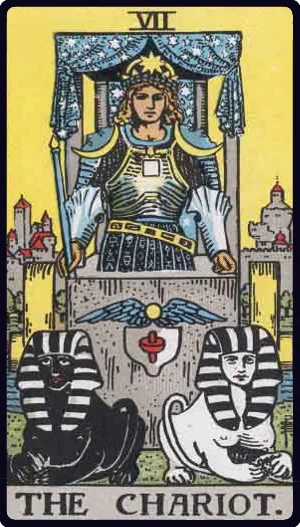
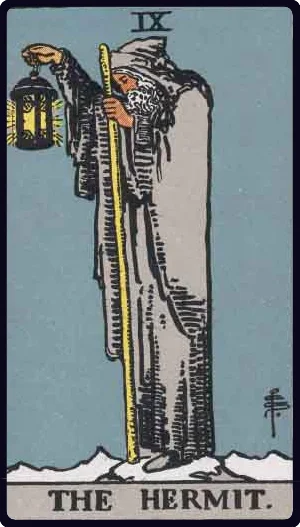
- List five visible details without using “progress,” “wisdom,” “success” or “isolation.”
- Circle one detail from each card that changes where your eye goes.
- Write two associations and label them as yours.
- Turn each card into a different two-hour experiment for the stated project.
Compare with one completed observation
The Chariot places two contrasting sphinxes before one vehicle; the Hermit raises a small light close to the figure. One contextual comparison could be coordinating several project parts versus examining one uncertain passage. Experiments: outline the next three sections and choose their order, or revise one paragraph while listing the questions it exposes. The visible images support the contrast; they do not prove that speed is good, solitude is required or completion is guaranteed.
Drill 2: describe people without assigning identities
Practice question: “What could help a small group review a prototype?”
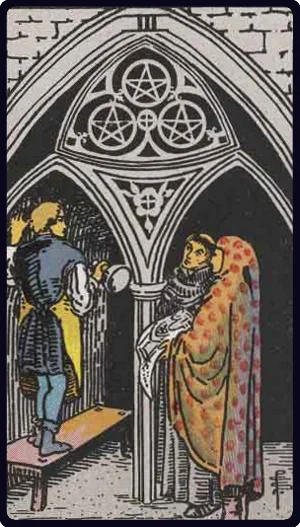
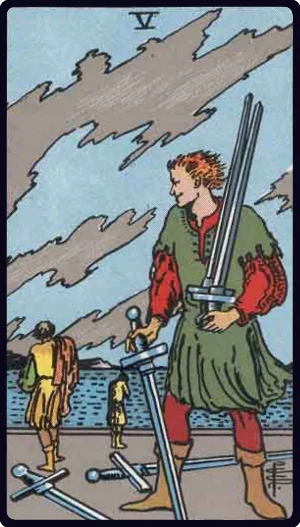
First describe positions, objects, gestures and distance. Then write two possible group processes. Avoid deciding that a pictured person is the manager, rival, liar or client. Those roles are not visible facts.
Compare with two process hypotheses
Three of Pentacles can prompt a review around a shared artefact and named criteria. Five of Swords can prompt checking whether the review rewards winning an argument instead of improving the prototype. A practical comparison is: one round where each person identifies evidence against the same checklist, versus an unstructured debate. The actual meeting behaviour would distinguish them. The cards do not diagnose a hostile colleague.
Open the references as a comparison, not a verdict
- Underline details the reference also discusses.
- Mark a traditional theme you did not notice; return to the picture and see whether it has a visible anchor.
- Keep a personal association only if it helps the question and you label it honestly.
- Remove claims about another person’s motive or a future event that neither the image nor the known facts support.
- Write one second interpretation. A richer vocabulary should expand comparison, not make the first sentence infallible.
Use the 78-card directory after completing a drill. The existing Practice tool reviews card meanings in five-card sessions; this page teaches the preceding observation step with side-by-side image evidence.
Demand and source scope
Learners repeatedly ask how to interpret rather than memorise. In the public discussions How do you tarot? and How to become more fluent with interpretations?, participants describe observing imagery, recording an initial response and checking a reference afterwards. Lumina’s three-layer method, questions and comparison drills are original exercises. Historical images are from the public-domain Rider–Waite–Smith deck; associations and applications remain interpretations, not visible facts or scientific findings.