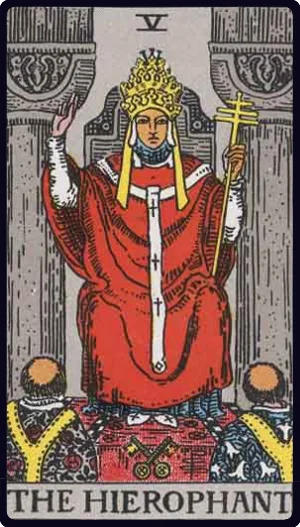
Pamela Colman Smith
The Hierophant Tarot Card Meaning
Understand a shared method before deciding how to follow or change it.
The Hierophant can bring a teacher, tradition or established procedure into focus. Shared knowledge can make learning possible without starting from nothing. The reading question is how a method serves its purpose, whether it fits the present situation and how questions about it are handled.
Upright meaning
The Hierophant can invite you to examine a shared method, teacher or tradition. Established guidance may help you learn something that would be difficult to discover alone. Ask what the guidance is intended to do and how well it fits the situation before following it automatically.
Look for guidance relevant to the task, not simply the most authoritative presentation. A useful teacher can explain the reason for an instruction and help you recognise when it applies. Following a method can be a way to learn its possibilities before deciding which parts need adaptation.
Reversed meaning
A familiar rule may no longer fit, or you may be rejecting a useful lesson simply because it comes from an institution. Distinguish a thoughtful adaptation from rebellion for its own sake. Name what you want to preserve and what needs changing.
Questioning a rule can reveal a needed change, but rejecting all guidance can also make a task harder. Identify the particular instruction and the concern you have about it. Separate disagreement about the group’s values from a practical problem with how its method works; the two may require different responses.
What to notice in the image
The first description names a visible detail. The reading prompt offers one way to interpret it in context.
- The teaching arrangement
Two figures face a seated central figure positioned above them between pillars.
Reading prompt: Who is passing on knowledge, and what room is available for the learner to ask questions?
- The crossed keys
Two keys cross near the feet of the central figure.
Reading prompt: Consider what access a shared method provides and whether you understand the conditions attached to it.
- The raised hand and staff
One hand is raised in a formal gesture while the other holds a staff with several crossbars.
Reading prompt: Ask which parts of the practice are explained openly and which are being followed through habit or deference.
Love and relationships
Upright
Discuss the beliefs and expectations each person brings to commitment. Shared assumptions are easier to work with when they are spoken aloud.
Reversed
A relationship may need an agreement that differs from an inherited model. Check that both people understand and choose it.
People can agree on a relationship label while bringing different inherited expectations to it. Discuss what commitment means in daily practice, including the influence of family or community. The card does not make one model obligatory. An agreement becomes meaningful through the people who understand and choose it.
Work, money and practical resources
Work — upright
Use a relevant example, established procedure or experienced teacher to understand the task before adapting the method.
Work — reversed
Ask whether a procedure serves the actual goal. Propose a specific improvement instead of assuming that every convention is either right or wrong.
Money and resources
Read the terms of a service or arrangement and ask questions about unfamiliar requirements. Familiar branding does not replace checking the details.
A worked reading
Question: How should I approach learning a craft with a method that initially feels restrictive?
Suppose a sewing instructor asks you to make a simple sample before attempting the garment you want. The Hierophant can prompt you to ask what the sample is meant to teach. If it demonstrates how the fabric behaves, trying the exercise may save frustration later. After understanding the purpose, you can discuss an adaptation that serves the same lesson. The reading does not require accepting every instruction; it invites you to distinguish an educational constraint from a rule whose purpose no one can explain.
Change the position, change the question
In Situation, identify the convention shaping expectations. In Action, consult a relevant method or teacher. In Consider, examine whether following the rule supports the actual aim and leaves space for informed questions.
The Hierophant and The Hermit
The Hierophant draws attention to learning through a shared framework. The Hermit draws attention to examining a question for yourself. They need not oppose each other: you can learn a method and then reflect on how it worked. Ask whether the current gap is missing guidance or insufficient time to evaluate what you have learned.
The Hierophant in a two-card reading
These pair readings include worked examples and explain how named positions can change the emphasis.
- The Hierophant + The TowerExamine what remains useful when an established rule is challenged.
- The Moon + The HierophantCompare an uncertain impression with the explanations you have inherited.
- The Fool + The HierophantLearn the convention before deciding how to adapt it
- The Magician + The HierophantTurn expertise into a lesson someone can use
Choose two cards in the Combination Explorer · How to read a pair
Number and correspondences
- Printed card number
- V · 5
- Element used here
- Earth
- Symbolic correspondence used here
- Taurus
This site’s birth-card calculator maps Life Path 5 to The Hierophant. The printed card number and the calculated Life Path are different kinds of information. This mapping belongs to the site’s chosen method; it is not a universal birth-card formula.
Correspondences offer an optional interpretive convention; they do not set a date for an event. See the element table and birth-card method for the rules this site uses.
Frequently asked questions
Does The Hierophant mean I must follow a religious tradition?
No. The religious imagery can also frame questions about teaching, community standards or an established way of working. The card does not prescribe a belief. Consider the specific guidance, its purpose and whether it fits your values and circumstances.
Is The Hierophant a yes or no card?
In this site’s Yes/No Oracle, The Hierophant upright is assigned Maybe. The fit depends on the agreement, values or requirements involved. Review those conditions instead of treating tradition as a factual answer. Every reversed card is assigned Maybe. These are the tool’s editorial conventions, not a universal tarot rule or verified odds.
Can The Hierophant tell me when something will happen?
The Hierophant does not provide a universal conventional timetable. If an event depends on an institution, course or shared process, consult its actual schedule and requirements. The card cannot establish when approval or completion will occur.
Take the reading into practice
Which rule is helping me learn, and which one needs to be examined?
Try: Find the reason behind one instruction before deciding how to apply it.
Sources and interpretation
Historical reference: A. E. Waite, The Pictorial Key to the Tarot, Part II.
The image observations above refer to the card shown on this page. The practical meanings, comparisons and worked example are Lumina Tarot’s editorial interpretations, not quotations from the historical text or verified predictions. Read our approach and correction process.