Pamela Colman Smith
The Emperor Tarot Card Meaning
Create enough structure for people to understand their responsibilities.
The Emperor can bring attention to the framework around a decision: who is responsible, which boundary applies and what counts as complete. Structure can support a shared purpose, but it becomes less useful when maintaining control replaces understanding the needs of the people involved.
Upright meaning
The Emperor can represent an agreement, boundary or structure that makes responsibilities clear. Ask what needs organising and who has authority to decide. A useful structure supports the people and purpose it serves; it can be reviewed when circumstances change.
A clear agreement can reduce the need for repeated supervision. Define the responsibility, give the person enough authority to carry it out and decide when the arrangement should be reviewed. The card need not describe a powerful individual; it may describe a process that makes ordinary cooperation easier.
Reversed meaning
Consider whether control has become too rigid or whether responsibilities are so unclear that work keeps falling through the gaps. Those problems need different responses. Clarify the decision and the people affected before adding another rule.
Too little structure and too much control require different changes. If tasks are falling between people, name an owner. If every small decision requires permission, consider where authority can be shared. Avoid responding to either problem by adding a blanket rule before you understand what is happening.
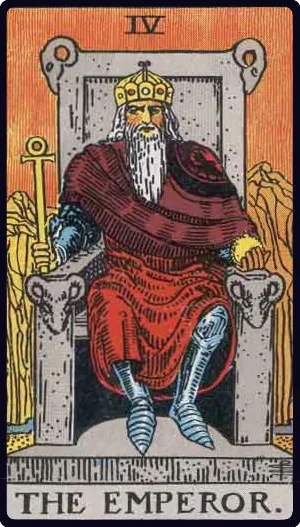
What to notice in the image
The first description names a visible detail. The reading prompt offers one way to interpret it in context.
- The stone throne
The figure sits squarely on a large, rigid throne with ram-head decorations.
Reading prompt: Which arrangement offers useful stability, and which part has become difficult to adjust?
- The sceptre and orb
A sceptre is held in one hand and a golden orb in the other.
Reading prompt: Ask how authority is defined and whether the person deciding also accepts responsibility for the result.
- The armour beneath the robe
Armoured legs are visible beneath the red clothing, with bare mountains behind the throne.
Reading prompt: Consider what a boundary protects and whether that protection still leaves room for a proportionate response.
Love and relationships
Upright
Make expectations about time, space and shared responsibilities explicit. A clear boundary should leave room for both people to speak.
Reversed
Check whether an agreement is mutual or one person is making every decision. The card is a prompt to examine the arrangement, not a verdict on someone's character.
Boundaries about time, space and responsibilities are easier to respect when they are stated and discussed. A relationship agreement should make room for both people’s needs. The Emperor does not mean one partner must take command, nor does it identify gender, age or authority from a card alone.
Work, money and practical resources
Work — upright
Define ownership, a realistic schedule and what counts as complete. Structure is useful when it reduces ambiguity.
Work — reversed
Review a rule that creates extra work without supporting the goal. Alternatively, identify one responsibility that needs a named owner.
Money and resources
Record existing commitments and recurring costs so that decisions rest on an accurate picture rather than a sense of control.
A worked reading
Question: How can we stop the same household task from becoming a repeated argument?
Use The Emperor to make the arrangement specific. Instead of agreeing that both people should do more, name the task, who owns it this week and what completion looks like. Check whether the person responsible has enough time and the necessary supplies. Agree to review the arrangement after trying it. The purpose of structure is to reduce uncertainty, not to create a scorecard for blame. If the card is reversed, ask whether the existing rule is unclear or whether one person has been assigning responsibilities without discussion.
Change the position, change the question
In Situation, identify the current authority or agreement. In Action, clarify a boundary or responsibility. In Consider, check whether the proposed structure serves its purpose without creating unnecessary control.
The Emperor and The Hierophant
The Emperor concerns organising responsibility and decision authority. The Hierophant concerns learning through a shared method, institution or tradition. A written process can involve both, but ask whether you need a clearer owner or a better understanding of why the method exists. Those are distinct questions.
The Emperor in a two-card reading
These pair readings include worked examples and explain how named positions can change the emphasis.
- The Fool + The EmperorAn open beginning needs a structure that leaves room to learn.
- The Hermit + The EmperorGive authority a reasoned basis and reflection a practical boundary.
- The Magician + The EmperorBuild a process around a demonstrated skill
- The High Priestess + The EmperorLet a clear structure include what is not yet known
Choose two cards in the Combination Explorer · How to read a pair
Number and correspondences
- Printed card number
- IV · 4
- Element used here
- Fire
- Symbolic correspondence used here
- Aries
This site’s birth-card calculator maps Life Path 4 to The Emperor. The printed card number and the calculated Life Path are different kinds of information. This mapping belongs to the site’s chosen method; it is not a universal birth-card formula.
Correspondences offer an optional interpretive convention; they do not set a date for an event. See the element table and birth-card method for the rules this site uses.
Frequently asked questions
Does The Emperor always represent an older man?
No. A courtly figure can serve as an image of a role, boundary or decision process. The card does not establish a person’s age or gender. In many readings, examining the arrangement is more useful than assigning the image to someone.
Is The Emperor a yes or no card?
In this site’s Yes/No Oracle, The Emperor upright is assigned Yes. A structured, clearly agreed action can fit this card. Check that the plan is workable and that the people involved have agreed to their roles. Every reversed card is assigned Maybe. These are the tool’s editorial conventions, not a universal tarot rule or verified odds.
Can The Emperor tell me when something will happen?
The Emperor cannot promise an outcome within a few weeks. A useful schedule depends on the work, the person responsible and the agreed deadline. Clarify those conditions rather than deriving a date from the card’s number.
Take the reading into practice
Where would a clear agreement help more than trying to control every detail?
Try: Clarify one responsibility, boundary or definition of done with the people involved.
Sources and interpretation
Historical reference: A. E. Waite, The Pictorial Key to the Tarot, Part II.
The image observations above refer to the card shown on this page. The practical meanings, comparisons and worked example are Lumina Tarot’s editorial interpretations, not quotations from the historical text or verified predictions. Read our approach and correction process.