Pamela Colman Smith
The Fool Tarot Card Meaning
Begin with curiosity and enough preparation to learn from the step.
The Fool brings the experience of being a beginner into a reading. Its openness can suggest possibility, while the edge in the image keeps practical limits in view. The useful question is what you could learn by starting, and how to make that first experience manageable.
Upright meaning
The Fool can represent a first step taken before the whole path is known. Notice what attracts you to the possibility, then check the practical conditions around it. Being a beginner leaves room for learning; it does not require ignoring an obvious constraint.
Separate the attraction of a new direction from the size of the commitment it requires. Taking one class, introducing yourself or making a rough first version gives you information that planning alone cannot provide. The Fool does not demand that you abandon experience; it invites you to allow a part of the situation to remain unfamiliar while checking the essentials.
Reversed meaning
Consider whether hesitation is keeping a manageable experiment out of reach, or whether excitement is replacing basic preparation. These are different possibilities. Identify the smallest step that would give you useful experience without committing to the entire journey.
Hesitation and recklessness can look like opposite problems, yet both can prevent useful learning. If you keep postponing, define a smaller experiment. If you keep rushing, identify the basic condition you have skipped. The reversal becomes more useful when it identifies a specific behaviour rather than labelling you as careless or fearful.
What to notice in the image
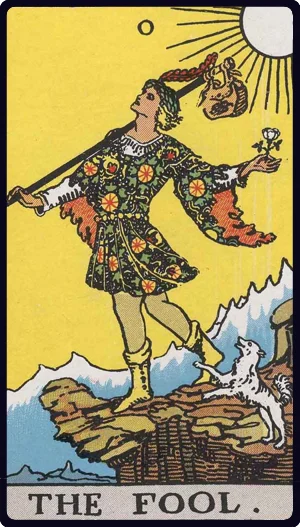
The first description names a visible detail. The reading prompt offers one way to interpret it in context.
- The cliff edge
The figure stands close to an edge while looking upward, away from the ground immediately ahead.
Reading prompt: What possibility has your attention, and which nearby constraint deserves a separate check?
- The small bundle
A compact bundle hangs from the staff carried over one shoulder.
Reading prompt: Consider what you already bring to a beginning and what you can learn without acquiring everything first.
- The white dog and flower
A white dog stands beside the figure, who holds a small white flower in an outstretched hand.
Reading prompt: Compare an immediate signal from your surroundings with the ideal or intention you are carrying into the situation.
Love and relationships
Upright
Approach a new interaction with curiosity while allowing time to understand each other's expectations. Initial excitement does not establish long-term compatibility.
Reversed
Check whether you are rushing an agreement or avoiding a straightforward conversation because the situation is new. State what you are ready for.
For a new connection, curiosity can coexist with clear expectations. Ask what each person wants now rather than treating a lighthearted beginning as either a promise of permanence or proof of unseriousness. If this is an established relationship, the new element might be an activity or conversation, not a new partner.
Work, money and practical resources
Work — upright
Try a limited first version of an idea. Define what you want to learn before choosing how much time and effort to commit.
Work — reversed
A first attempt may need a clearer brief or a smaller scope. Starting imperfectly is different from starting without checking the essentials.
Money and resources
List the resources an experiment requires and what you can use already. The card does not predict a windfall or remove the consequences of a purchase.
A worked reading
Question: Would trying a new hobby help me find out what I enjoy?
Suppose you are interested in pottery but have never worked with clay. Reading The Fool as a prompt, you could book one introductory session, check what materials are provided and leave a larger equipment purchase for later. Notice whether you enjoy the actual process as much as imagining the finished objects. The outcome you are seeking from this first step is information about your interest, not immediate competence. If the card is reversed, ask whether the obstacle is the cost of the trial or the expectation that you should already be good at it.
Change the position, change the question
In Situation, The Fool can frame the unfamiliarity of the experience. In Action, it can suggest a limited first attempt. In Consider, it can ask what preparation or consequence enthusiasm has left outside the picture.
The Fool and The Magician
The Fool explores before the whole method is known; The Magician focuses on deliberately using available tools. When choosing between their questions, ask whether you first need experience of the situation or a clearer use of a skill you already possess. Beginning and acting competently can overlap, but they draw attention to different needs.
The Fool in a two-card reading
These pair readings include worked examples and explain how named positions can change the emphasis.
- The Fool + TemperanceMaking room for exploration within a workable rhythm
- The Fool + The WorldCarrying a completed experience into a new beginning
- The Fool + The SunExploring openly while checking what experience reveals
- The Fool + Wheel of FortuneBeginning flexibly when circumstances are changing
Choose two cards in the Combination Explorer · How to read a pair
Number and correspondences
- Printed card number
- 0 · 0
- Element used here
- Air
- Symbolic correspondence used here
- Uranus
This site’s birth-card calculator maps Life Path 22 to The Fool. The printed card number and the calculated Life Path are different kinds of information. This mapping belongs to the site’s chosen method; it is not a universal birth-card formula.
Correspondences offer an optional interpretive convention; they do not set a date for an event. See the element table and birth-card method for the rules this site uses.
Frequently asked questions
Does The Fool mean I should take a leap without thinking?
No. The image can encourage openness while also prompting you to notice the edge. A useful reading identifies a manageable first step and checks its basic conditions. It does not require ignoring a risk or making an irreversible commitment.
Is The Fool a yes or no card?
In this site’s Yes/No Oracle, The Fool upright is assigned Yes. Read as encouragement to explore a manageable first step. Check the conditions before treating a new possibility as a commitment. Every reversed card is assigned Maybe. These are the tool’s editorial conventions, not a universal tarot rule or verified odds.
Can The Fool tell me when something will happen?
The Fool does not set a deadline or prove that a surprise will arrive soon. If you want to begin something, choose a realistic date for a small trial based on your available time and the preparation it needs.
Take the reading into practice
What could I learn from a small first step that further imagining would not tell me?
Try: Define a short, reversible experiment and one question it should answer.
Sources and interpretation
Historical reference: A. E. Waite, The Pictorial Key to the Tarot, Part II.
The image observations above refer to the card shown on this page. The practical meanings, comparisons and worked example are Lumina Tarot’s editorial interpretations, not quotations from the historical text or verified predictions. Read our approach and correction process.