Pamela Colman Smith
Two of Wands Tarot Card Meaning
Choose a direction from where you stand
The Two of Wands brings an idea into the planning stage. You can see more than one possible direction, but imagining a wider world is different from choosing how to enter it. Read the card around scope, priorities and the information a decision still needs.
Upright meaning
The elevated viewpoint suggests taking stock before extending your reach. What is already stable, what do you hope to change, and which option fits your present capacity? A useful plan connects the ambition to the place you are starting from.
This can be a moment to select between two workable approaches rather than waiting for a perfect one. Name the tradeoff you are accepting. A choice becomes clearer when you can explain both what it offers and what it leaves for later.
Reversed meaning
Reversed, planning may become a holding pattern: more comparisons, more imagined possibilities, but no clearer decision. Alternatively, a large vision may rest on a detail you have not checked. Ask whether the next need is commitment or information.
Keep a small decision separate from a permanent one. Trying an option for a defined period may be possible even when committing to it indefinitely feels unreasonable. A limited trial needs a purpose and a point at which you will review it.
What to notice in the image
Start with what is pictured, then try the reading prompt. An image detail and an interpretation are different kinds of information.
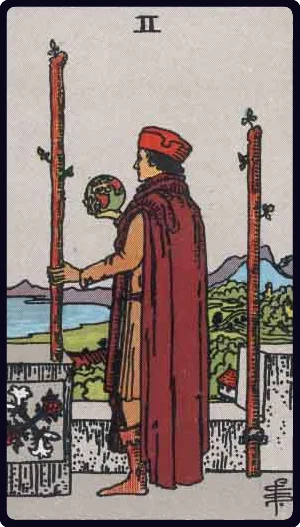
- The globe in the hand
The figure holds a small globe while looking out over the landscape.
Reading prompt: A broad possibility can fit easily in your imagination. What practical detail is missing from that overview?
- Two differently placed staffs
One wand is held; the other is attached beside the figure.
Reading prompt: Consider the relationship between an established base and an option you can actively shape.
Love and relationships
Upright
The Two can describe discussing where a relationship is going, how to handle distance or which experiences you want to share. Make room for two people's plans; a private vision becomes a shared direction only through agreement.
Reversed
One person may be assuming a plan has been settled while the other is still considering it. Talk about the next concrete decision, such as a visit or living arrangement, rather than asking for a promise about the entire future.
Work and practical resources
Upright
Compare projects by scope, available time and the kind of work each requires. A written choice can make it easier to stop reopening the decision whenever another attractive idea appears. Keep a place for later ideas without treating them all as current commitments.
Reversed
Check for a plan based only on the most appealing outcome. Who will do the work, what depends on someone else, and what would make you revise the plan? Answering one missing question may be more useful than another broad strategy session.
Time, attention and materials
Compare what each option asks from your time, attention and existing materials. Include the ongoing demands as well as the exciting first step.
A worked reading
Question: Should our book club stay online or try a local meeting?
Members like both ideas, but nobody has checked who could attend in person. The Two appears as Advice.
Use the card to turn a broad choice into a workable comparison. Ask members about availability, identify a suitable venue and agree on the purpose of a trial meeting. Keep the online option available during the trial. You can then decide using attendance and feedback instead of imagining that one format must be better.
Change the position
As a Situation, the Two may describe a decision still open. As an Obstacle, it may point to a plan designed from one person's viewpoint without the participation of those who need to carry it out.
Distinguish this card from nearby themes
Two of Wands and Three of Wands
The Two weighs and chooses a direction. The Three considers what happens after something has been sent into the world: a proposal, application or first shipment. Ask whether you are deciding or responding.
Compare: Three of Wands
Two of Wands and Ace of Wands
The Ace supplies the first spark. The Two tests its scope. More inspiration may not help when the real task is choosing which idea receives your limited attention.
Compare: Ace of Wands
Take the reading into practice
Reflect: What information would actually change my choice?
Try: Write down two workable directions and one practical question about each. Seek those answers before adding more options.
Frequently asked questions
Does the Two of Wands mean I should move abroad?
The globe and distant view can invite thoughts about travel or a wider horizon. They do not instruct you to relocate. If moving is your actual question, compare the concrete arrangements and alternatives before deciding.
Is the Two of Wands always about two choices?
Two options can be a helpful example, but the image need not describe a literal pair. It can also concern the relationship between an existing base and a possible expansion.
Read within the suit
Wands use Fire as a symbolic element in this guide. Initiative, effort and how an undertaking develops. The individual image gives the reading its focus; a rank or an element does not set a calendar date.
Use a physical deck or choose a card from the Wands list to practise. The site’s Daily Draw, Three-Card Spread and Yes/No Oracle use only the 22 Major Arcana, so this Minor card is not an available draw result.
Sources and interpretation
Historical image descriptions: A. E. Waite, The Pictorial Key to the Tarot, Part III, section 2, the suit of Wands.
The observations refer to the card displayed above. The practical readings, comparison prompts and worked scenario are Lumina Tarot’s modern editorial interpretations. They do not reproduce every historical meaning, and reversal conventions vary. See our approach and correction process.