Case files · compare interpretations
Conflicting Tarot Cards: Work Through the Tension
Two different themes do not automatically cancel each other out. Read the question and each card’s role before choosing between them. These case files show how to keep a useful contrast—and when to leave a reading unresolved.
Check what is actually in conflict
“Move” and “pause” can sound incompatible until you ask what is moving and what needs a pause. Keep the question, card positions and orientations you chose before drawing. Do not add a secret motive or a new timeline just to make the cards agree.
- Replace each keyword with a sentence. Name the part of the situation that the card could describe. “The Chariot means go” leaves out both the destination and the limits.
- Check the roles. An opportunity and a caution can both apply. A card in Advice does not have to describe the present situation.
- Write a second plausible reading. Keep the same question and positions. Change the proposed interpretation, not the facts.
- Name a fact that would distinguish them. An actual deadline, completed task or direct answer is more informative than another card used as a vote.
- Leave room for no fit. If neither reading is supported, record the uncertainty and stop. An unresolved reading is a usable result.
All three cases below are invented learning exercises using upright Rider–Waite–Smith cards. The scenarios show a method for checking an interpretation; they are not accounts of consultations or predictions.
Case 1: The Chariot and The Hanged Man — keep the goal, test the approach
Question: “How can I prepare my pottery stall for Saturday?” The maker has ten finished pieces, a booked table and an untested display. They are considering making fourteen more pieces before the event.

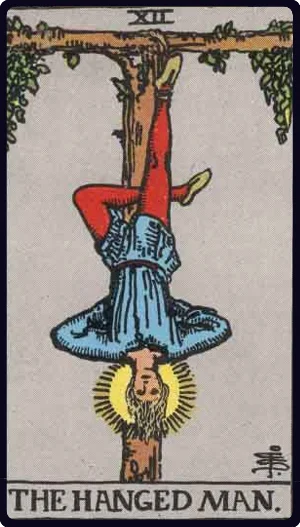
Observe first. The Chariot places two differently coloured sphinxes before one vehicle. The Hanged Man suspends a figure in an inverted position. Coordination and a change of viewpoint are possible themes; the images do not establish the maker’s capacity.
Two readings of the same assigned positions
Reading A — pause production to coordinate what is ready. The deadline gives the preparation a direction. Testing the display from a visitor’s viewpoint could be more useful than adding stock. Here the pause concerns one activity, while the stall preparation continues.
Reading B — question an overambitious target. The maker may be steering several demands toward a deadline without enough time. The useful pause could be reducing the plan to ten pieces rather than assuming more production is necessary.
The fact that would help choose: lay out the ten pieces on a table of the confirmed size, then list the actual drying, finishing and packing time available. A complete display with spare space for labels supports A. An already overloaded timetable supports B. The card does not settle either test in advance.
One action: make a full-size trial display today and decide on additional production only after that check. “Move” and “pause” have become a bounded plan, not opposing commands.
What changes if the positions were assigned the other way around?
In a separate exercise with The Hanged Man as Situation and The Chariot as Advice, the focus might be a stalled preparation that needs a chosen direction and coordinated tasks. That reading starts from a pause rather than recommending one. The maker would still check the actual timetable. Do not swap the positions of the original draw after seeing the result and then call the new reading confirmation.
Case 2: The Sun and The Moon — separate what is known from what is missing
Question: “What should we check before opening registration for our community drawing workshop?” The organisers have a finished demonstration and a proposed room, but have not yet received the room’s access instructions.
Assigned positions: The Sun, upright, in What is working; The Moon, upright, in What needs checking.
Image observations: The Sun shows a child on a white horse under a large sun. The Moon shows a winding path between towers, with animals beside it. An openly visible part of the project can coexist with an unclear part; one card does not cancel the other.
Two readings to compare
Reading A — the activity is understandable; the logistics are incomplete. The demonstration is ready to show, while entry arrangements need a direct answer from the venue. The uncertainty has a specific, checkable location.
Reading B — the organisers’ enthusiasm is clear, but the instructions may not be. A polished demonstration can look easy to its creator. The missing information may include how a first-time participant understands the task, not only how they enter the building.
The fact that would help choose: ask a willing beginner to follow the first instruction without coaching. If they can begin and the venue is the only outstanding item, A has support. If they cannot tell what to do, B identifies another practical gap. Both could apply; this is not a contest in which one card must win.
One action: obtain the venue instructions and run that short beginner test before publishing the registration details. Record each result separately. Neither uncertainty nor a positive card establishes that anyone is deceiving the organisers.
Case 3: The Star and The Tower — when neither proposed reading fits
Question: “What would help me prepare Saturday’s book group?” The room and attendance are confirmed. The discussion prompts have been tried with a willing friend, and no practical issue has emerged.
Assigned positions: The Star, upright, in Obstacle; The Tower, upright, in Advice.
Image observations: The Star’s figure pours water onto land and into a pool. The Tower shows a lightning-struck structure with figures falling beside it. The images offer themes of replenishment and disruption; they do not prove that a hidden crisis exists.
Two possibilities, neither automatically justified
Reading A: hope is replacing preparation, so a weak assumption needs to be challenged. That interpretation would need evidence of an unchecked arrangement. The stated facts currently point the other way.
Reading B: trying to make the gathering feel encouraging is keeping an unsuitable format in place. That would need specific feedback that the format prevents people from joining in. None has been reported.
A fact that could change the reading: a participant might identify an inaccessible format or the venue might change the booking. Those would be new facts to address if they arise. Imagining them is not evidence that they will.
One action: keep the workable plan, leave an ordinary opening for participants’ preferences, and record: “Neither interpretation fits the information available.” Do not manufacture a problem, abandon the booking or draw until a reassuring explanation appears.
A four-line record for your own reading
- My original question and assigned positions were…
- The apparent conflict is between… and…
- Two possible interpretations are…; a fact that would distinguish them is…
- I will check…; for now, the part that remains unresolved is…
Keep this record in the reading journal. If the problem is one unclear position rather than a disagreement, use the clarifier decision guide. If no positions were chosen, use the unpositioned reading exercise instead of inventing roles afterwards.
Method and sources
Joan Bunning’s Lesson 15: Card Pairs discusses contrasting and reinforcing themes as a practitioner’s interpretive approach. The three scenarios, competing explanations and evidence checks above are Lumina Tarot’s original teaching examples. They are not quotations, universal rules or evidence of predictive accuracy. Card imagery and reference descriptions use the site’s Rider–Waite–Smith sources and editorial approach.
For the general method of connecting two cards, read How to Read Card Combinations. This page addresses what to do when a connection seems contradictory or cannot be supported.