Visual exercise · build and check a reading
Reading Tarot Without a Spread: A Three-Card Practice
You can read a small group of cards without assigning a role to each place on the table. You still need a clear focus and a way to check your interpretation. Try this unpositioned exercise with the illustrated cards below or your own deck.
Unpositioned cards still need a question
You can draw a few cards without assigning a different job to each one. The question then provides their shared context. A three-card row is not automatically Past, Present and Future; that would be a position system you needed to choose before the draw.
- Set the scope before drawing. Write one question, choose the number of cards and decide whether to use reversals. For this exercise, use three upright cards. Three is a manageable limit for practice, not a rule about what a reading must contain.
- Record the draw as it happened. Keep the original card names and order in your notes. Describe one visible detail in each image before reaching for a keyword.
- Find a relationship. Look for a shared activity, a contrast or a condition one theme places on another. All three cards should contribute to the proposed sentence.
- Write another reasonable sentence. An unpositioned draw can support more than one emphasis. Do not call the second version a correction merely because you like it better.
- Check both against the situation. Identify the facts that support each, the information missing, and a small action you can actually evaluate. You may keep a tentative interpretation or leave both unresolved.
This exercise is for a physical deck or cards you have already drawn. Lumina’s Three-Card Spread has named positions; its generated text should still be read within the layout selected there.
Worked example: returning to sketching
Invented learning example with deliberately chosen cards. Use the stated situation to compare the interpretations; this is not a record of a real reading.
Question: “How could I make returning to sketching practical next week?” The reader has pencils and paper, two free twenty-minute sessions, several unfinished sketches and a friend willing to comment on one picture. They have not shown anyone their work recently.
Recorded draw: The Hermit, The Magician and Eight of Pentacles, all upright. No positions were assigned. The card order below records the draw; it does not describe a sequence of future events.


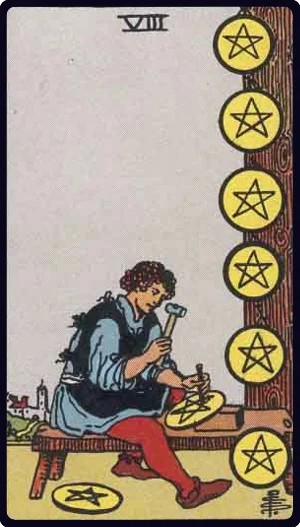
Try a sentence before opening the examples
Connect close attention, available tools and repeated practice to the stated question. Avoid assigning “past” to The Hermit or promising that the final card guarantees mastery. What could the reader do within the two sessions?
Possible synthesis A: make the practice small enough to repeat
Sentence: “Choose one detail to study, use the materials already available, and compare two attempts at that detail.” The Hermit contributes a narrow focus, The Magician an inventory of usable tools, and Eight of Pentacles a repeatable task.
Action: draw the same mug for ten minutes in each session, then note one difference in proportion. Use the remaining time to observe the mug or make a short note. Buying new materials is not required by these cards or by the stated task.
Counterevidence: if the reader already practises this way and remains stuck because they cannot identify an error, “repeat more” may add little. Their existing sketchbook, rather than the card order, would show whether the missing ingredient is practice time or useful feedback.
Possible synthesis B: bring private work into a feedback loop
Sentence: “Review one unfinished sketch, turn the review into a visible revision, and use specific feedback to guide the next attempt.” The same lantern can suggest looking closely at existing work; the table of tools can suggest making the intended change; the worked pieces can suggest learning through comparison.
Action: choose one sketch and ask the willing friend a narrow question such as “Which edge makes the mug look tilted?” Make one revision, then compare it with the original. The friend’s response is information to examine, not an authoritative verdict on the reader’s ability.
Counterevidence: if the friend cannot give useful feedback or the reader has no specific feature to examine yet, this plan may be less helpful than the small repeated study in A. The invitation to share comes from the scenario and the chosen interpretation; The Hermit does not secretly require either isolation or publicity.
What the reader can conclude: both versions offer feasible experiments. A may suit a need for a routine; B may suit a need for feedback. The reader can choose one and review what it actually changes. The draw does not reveal which experiment must succeed.
Using an order as a lens is different from discovering a timeline
After recording an unpositioned draw, you may deliberately try a sentence such as “focus, make, practise” or examine which theme feels central. Label that as an exploratory lens you are adding. It is a way to organise your thoughts, not a role assignment that existed before the cards appeared.
For the sketching example, starting your sentence with Eight of Pentacles could emphasise the practice routine, then ask what focus and tools support it. Starting with The Magician could emphasise what is ready to use. Neither rearrangement supplies a new fact, a deadline or a more accurate forecast.
If you want each card to answer a separate question, choose a defined layout for a future draw. See Questions Before Positions. Keep the current record unchanged so you can distinguish the original draw from later experiments.
Your turn: choose a manageable weekend project
This second invented scenario uses deliberately chosen cards for practice.
Question: “What would help me choose a craft project I can finish this weekend?” The reader has two free hours and materials left from three unfinished projects. They feel little enthusiasm for those projects, but have an idea for a simple bookmark they have not tried.
Unpositioned draw, all upright: Four of Cups, Two of Pentacles and Ace of Wands.
- Four of Cups shows a seated figure with folded arms beside three cups and an offered fourth cup.
- Two of Pentacles shows a figure holding two pentacles within a looping band.
- Ace of Wands shows a hand emerging from a cloud and holding a leafy staff.
Write one sentence that includes all three themes. Then name a fact that might challenge your sentence. You do not have to explain the reader’s lack of enthusiasm as a hidden message.
Compare your sentence with one possible approach
“Examine the lack of interest, fit the choice to the available time, and give one new idea a small trial.” Four of Cups contributes examining the offer rather than dismissing it automatically; Two of Pentacles contributes managing competing demands; Ace of Wands contributes beginning something limited.
A practical trial could be sketching a bookmark and listing its steps before committing the whole two hours. If the steps require materials that are not available, shorten the design or choose one unfinished project with a clear finish point. The new idea is not automatically the better choice.
A different reading might emphasise rest: low interest and too many competing tasks could make another start unhelpful today. The reader’s actual energy, available time and existing commitments would help distinguish these possibilities. An image alone cannot diagnose why interest is low.
Keep a short record without adding more cards
In the reading journal, write “unpositioned” in the cards-and-positions field. Keep the original order, the question, both proposed sentences and the fact you plan to check. Add what you observed later without rewriting the original interpretation.
If the cards seem to disagree, use the conflicting-card cases. If one part remains unclear, the clarifier guide helps distinguish an extra interpretive question from information that needs a real-world source. If cards fell out while shuffling, settle how you will handle those jumper cards before treating them as additional positions.
Method and sources
Labyrinthos’ introductory reading guide describes both using a spread and drawing a few cards to combine their meanings. The workflow, scenarios and competing syntheses on this page are Lumina Tarot’s original editorial exercises, not a single universal reading method. They do not establish predictive accuracy. Image references follow the site’s Rider–Waite–Smith sources.
For a simpler two-card introduction, use How to Read Card Combinations. This exercise adds an explicit method for keeping several unassigned cards in one question without inventing fixed positions after the draw.