Understand the difference
Death vs The Tower: Two Different Kinds of Change
Death asks what has reached an ending and needs a transition. The Tower asks what a disruption exposes about the structure you were relying on. Both can involve change, but they direct attention to different work.
A useful distinction goes beyond 'slow change versus sudden change'. An ending can arrive unexpectedly, and a weakness can be visible long before a structure fails. Start by naming what has actually changed. Then ask whether you need to close a chapter, examine an assumption, or do both.
Compare the two questions
| Focus | Death | The Tower |
|---|---|---|
| Main focus | An ending, release or change of phase. | A disruption that challenges an existing arrangement. |
| Useful question | What is finished, and what needs a proper handover? | What did I assume would hold, and what needs checking now? |
| Advice emphasis | Complete the transition instead of preserving the old role indefinitely. | Respond to the immediate facts and rebuild on a sounder basis. |
| Easy mistake | Treating every uncomfortable feeling as a reason to end something. | Assuming that a dramatic image guarantees a disaster. |
| What the card cannot establish | That a person will die or a relationship must end. | That an accident, betrayal or catastrophe will occur. |
Start with what is in the images
Death
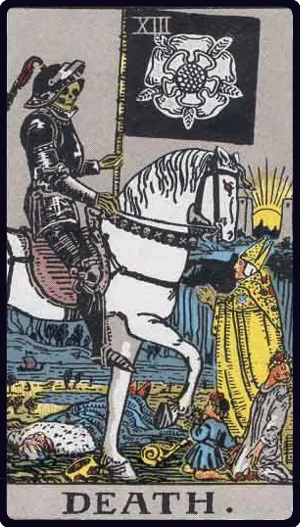
Death shows an armoured rider moving past figures on the ground. Read the movement as a prompt to examine a passage from one phase to another; the picture cannot diagnose an event.
The Tower
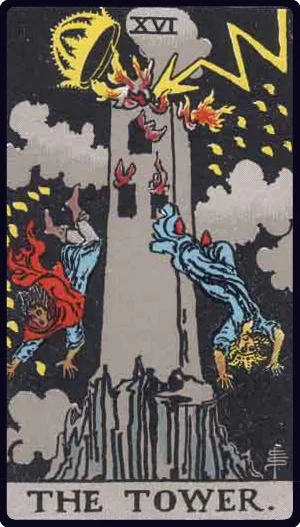
The Tower shows lightning, a displaced crown and falling figures. The image draws attention to an interrupted structure. Ask which part of an arrangement has been exposed, instead of treating the whole future as ruined.
One situation, two advice cards
What should our community workshop do after losing its usual venue?
The venue owner has confirmed that the room will no longer be available. Several sessions are booked. You have participant contact details, materials in storage and a possible alternative location.
If Death is Advice
With Death in Advice, concentrate on closing the old arrangement: collect materials, settle the final room booking and explain the transition to participants. Decide which parts of the workshop still belong in the next version. The card helps frame closure; the owner's message, rather than the card, establishes that the room is unavailable.
If The Tower is Advice
With The Tower in the same Advice position, examine what the loss exposes. Perhaps the group had no backup location or one person held every contact detail. Confirm immediate needs, communicate the changes and make responsibilities less dependent on one room or person. An exposed weakness is something you can address, not proof that the workshop itself is a failure.
If both themes apply
If both cards appear, closing the venue arrangement and improving the way the group operates can happen together. Give each card a named position so that the interpretation produces two clear tasks rather than two versions of 'everything will change'.
How reversals change the question
Reversed Death can invite you to examine unfinished closure or resistance to a transition. That might mean an unclear handover rather than a refusal to let go. Check the practical obstacle before judging yourself.
Reversed Tower can focus on an avoided repair, contained disruption or the aftermath of a change. It does not guarantee that trouble has been prevented or that a worse event is waiting.
Relationships and work
In a relationship reading
Death can frame the end of an old relationship pattern, role or agreement. Ask what is actually ending; a changed routine is not automatically a breakup.
The Tower can prompt an honest check when expectations no longer match the situation. It cannot establish that a partner has lied. Discuss the specific mismatch and allow the other person to respond.
In a work reading
Death may be useful when completing a project, leaving a role or retiring an outdated method. List the remaining obligations and the knowledge someone else will need.
The Tower may focus attention on a failed assumption, fragile process or unexpected change in access. Separate immediate continuity from longer-term repair instead of trying to solve everything in one move.
Common shortcuts to question
- Death is always gradual and The Tower is always sudden.
These are helpful associations in some readings, not a reliable timetable. The stronger distinction is transition versus an exposed structure.
- Both cards mean I should abandon the situation.
A reading may lead to closure, repair or a changed approach. Choose using the actual facts, options and consequences.
Try the distinction yourself
A hobby group has outgrown its old format. Which question would you ask first with each card?
Show two possible reading questions
Death: What part of the old format needs a clear ending before the next version begins?
The Tower: Which assumption about the format no longer holds, and what does that reveal?
Write one closure task and one repair task. If they turn out to be the same task, explain why the two cards still bring a different reason for doing it.
Questions about this comparison
What is the main difference between Death and The Tower?
In this guide, Death emphasises endings and transition, while The Tower emphasises disruption and challenged assumptions. A single situation can contain both themes.
Does either card predict physical death or disaster?
No. These symbolic images cannot establish that someone will die or that a disaster will happen. Interpret the theme in context and use real information for practical decisions.
What if I draw Death and The Tower together?
Name the positions and separate the tasks. For example, Death in Situation may describe a confirmed ending, while The Tower in Advice may prompt a review of the structure that needs repair.
Keep the individual cards in view
Death in depth · The Tower in depth
To interpret both cards in one spread, read their combined meaning. This comparison explains their differences; the pair article explains how they can interact.
Explore all five comparisons · How to read two cards together
Images and interpretation
The pictured cards use Rider–Waite–Smith imagery by Pamela Colman Smith. Historical descriptions: A. E. Waite, The Pictorial Key to the Tarot, Part II and Part III. The distinctions, scenarios and exercises here are Lumina Tarot’s modern editorial interpretations. They are not quotations, universal rules or reports of consultations.