Pamela Colman Smith
The Devil Tarot Card Meaning
Examine the reward, cost and constraint that keep a pattern in place.
The Devil can prompt examination of an attachment, incentive or arrangement that feels difficult to question. The chains offer an image for constraint, while the human figures keep attention on the experience of being within it. Ask what maintains the pattern and which choices are actually available.
Upright meaning
The Devil can invite an honest look at an attachment, incentive or habit that narrows your choices. Ask what keeps the pattern in place and which alternatives are available. The card does not prove that another person is malicious or that you have a particular condition.
Name both the benefit and the cost. A habit or commitment can persist because it provides something real, even while creating a problem elsewhere. Understanding that exchange is more useful than simply condemning it. Some constraints are practical and substantial; the card does not make them imaginary or suggest that change is effortless.
Reversed meaning
Consider whether you are beginning to recognise a restrictive pattern or finding it difficult to change despite that recognition. Awareness can be a first step, but change may need practical support, different conditions or a clearer boundary.
The possibility of loosening an attachment can be a useful question, but a reversed draw does not prove that you are already free of a pattern. Identify the support, alternative or change of conditions that would make a different response possible. Avoid treating one moment of resolve as the whole process.
What to notice in the image
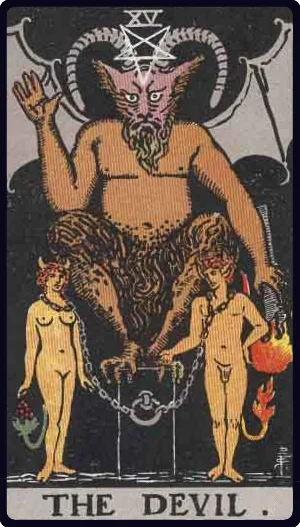
The first description names a visible detail. The reading prompt offers one way to interpret it in context.
- The linked figures
Chains connect the two human figures to a ring on the central pedestal.
Reading prompt: What links the people or activities in this arrangement, and what would changing that connection require?
- The central figure
A large horned and winged figure occupies the space above the smaller figures.
Reading prompt: Which incentive, rule or fear has become disproportionately influential in the decision?
- The torch and tails
The central figure holds a downward-pointing torch, while the smaller figures have distinct tails.
Reading prompt: Notice what feeds the recurring response and whether a short-term reward is making a longer-term cost less visible.
Love and relationships
Upright
Examine whether attraction or fear of loss is making an arrangement difficult to evaluate. Keep the focus on observable behaviour and your boundaries.
Reversed
Identify one boundary or source of support that could make a different choice possible. A reversal does not guarantee that a difficult dynamic has ended.
Strong attraction and dependence are different questions. Examine whether both people can express a preference, set a boundary and discuss the terms of the relationship. The Devil does not diagnose a partner or establish that someone is abusive. Decisions about an actual harmful situation should rest on conduct and available support, not a card label.
Work, money and practical resources
Work — upright
Look at the incentives and obligations that keep a frustrating process in place. A useful change addresses those conditions, not just the frustration.
Work — reversed
Review which part of a restrictive routine you can change and which part requires another person's agreement.
Money and resources
Notice recurring costs, obligations or habits that limit flexibility. Gather the facts before deciding what can be changed.
A worked reading
Question: Why do I keep accepting an optional commitment that leaves me frustrated?
Suppose you repeatedly volunteer for extra tasks because being needed feels rewarding, then find that your own plans have no time left. The Devil can prompt an honest account of both sides: the recognition you receive and the capacity you give up. Try one clear limit on the next request and observe the actual response. You may discover a workable boundary or a need for a larger change. The reading does not make the commitment bad by definition; it helps you see the exchange you have been repeating.
Change the position, change the question
In Situation, identify the attachment or constraint. In Action, examine the incentive and a realistic alternative. In Consider, ask which consequence or dependence is being overlooked because the immediate reward is compelling.
The Devil and The Lovers
The Devil can ask what makes a choice feel constrained or difficult to reconsider. The Lovers can ask how a freely discussed choice expresses values. Neither card determines the quality of a relationship by itself. The comparison is useful when it helps you examine actual consent, expectations and the practical freedom to respond differently.
The Devil in a two-card reading
These pair readings include worked examples and explain how named positions can change the emphasis.
- The Devil + JusticeExamine a binding arrangement through facts, responsibility and a fair accounting.
- The Fool + The DevilCheck the strings attached to an exciting opening
- The Magician + The DevilDistinguish influence from pressure
- The High Priestess + The DevilExamine the pull of something you keep private
Choose two cards in the Combination Explorer · How to read a pair
Number and correspondences
- Printed card number
- XV · 15
- Element used here
- Earth
- Symbolic correspondence used here
- Capricorn
The Devil is not a direct result in this site’s birth-card calculator. The printed card number does not mean that a person has a matching Life Path or that a date determines their personality.
Correspondences offer an optional interpretive convention; they do not set a date for an event. See the element table and birth-card method for the rules this site uses.
Frequently asked questions
Does The Devil mean I am cursed or that someone is evil?
No. The image does not establish a curse, a supernatural threat or a person’s moral character. Here it is used to examine attachment, incentives and constraints. Describe the specific pattern and its effects instead of applying a frightening label to yourself or someone else.
Is The Devil a yes or no card?
In this site’s Yes/No Oracle, The Devil upright is assigned No. Read as a caution about a restrictive or poorly examined pattern. The label does not establish facts about a person or require an immediate major decision. Every reversed card is assigned Maybe. These are the tool’s editorial conventions, not a universal tarot rule or verified odds.
Can The Devil tell me when something will happen?
The Devil does not set an event for Capricorn season or indicate how long an attachment will last. Change depends on the particular pattern, available alternatives and support. Identify a realistic next step and review its actual effect.
Take the reading into practice
What keeps this pattern in place, and which choice am I overlooking?
Try: Name one practical condition that would make a different response easier.
Sources and interpretation
Historical reference: A. E. Waite, The Pictorial Key to the Tarot, Part II.
The image observations above refer to the card shown on this page. The practical meanings, comparisons and worked example are Lumina Tarot’s editorial interpretations, not quotations from the historical text or verified predictions. Read our approach and correction process.