Understand the difference
Strength vs Temperance: Steady Restraint or Careful Adjustment?
Strength asks how to meet pressure with patient, firm effort. Temperance asks how to adjust the mixture, pace or proportions so an arrangement becomes more workable.

Both can suggest patience, but patience is not one action. You might need to hold a boundary through an uncomfortable moment, or change the conditions that keep producing the difficulty. Strength is useful for examining your response to pressure; Temperance is useful for examining the arrangement itself.
Compare the two questions
| Focus | Strength | Temperance |
|---|---|---|
| Main focus | A steady response to effort, emotion or pressure. | Adjustment, integration and workable proportions. |
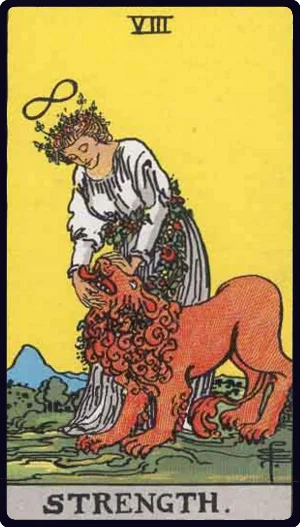
| Image cue | A figure attends closely to a lion. | A figure pours between two cups. |
| Useful question | How can I remain firm without escalating? | Which small adjustment would make this more sustainable? |
| Advice emphasis | Use patient effort, clear limits and a measured response. | Test the balance of time, inputs and expectations. |
| Easy mistake | Believing strength means tolerating unlimited strain. | Believing balance means giving every demand an equal share. |
Start with what is in the images
Strength
Strength shows a figure beside a lion, with hands near its mouth. The close interaction provides a prompt about the way effort is applied. It need not be read as domination or as the obligation to tame another person.
Temperance
Temperance shows liquid passing between two cups, with one foot in water and one on land. The image makes adjustment and connection visible. A useful proportion is responsive to the task; it is not necessarily a fifty-fifty split.
One situation, two advice cards
How can our volunteer group make its weekly session less exhausting?
The group offers a craft session after work. People enjoy it, but preparation takes too long and last-minute requests extend the evening. You become frustrated when another activity is added just before the session begins.
If Strength is Advice
With Strength in Advice, focus on your response at that moment. State the limit clearly: the group can complete the planned activity tonight and consider the extra request later. Use a calm, direct explanation without promising more than you can sustain. The card supports a firm response; it does not ask you to conceal every feeling or absorb the extra work indefinitely.
If Temperance is Advice
With Temperance in the same Advice position, adjust the process. Try a shorter activity, distribute preparation earlier or set a deadline for additions. Change one variable and see whether the next session is easier to run. The aim is a workable mixture of ambition, time and capacity, not a compromise that leaves everyone exhausted.
If both themes apply
A clear boundary can protect tonight's session while an adjusted process improves the next one. Strength helps you hold the limit; Temperance helps you design conditions that need less repeated effort to hold.
How reversals change the question
Reversed Strength can invite attention to depleted capacity, harsh self-control or a response that becomes forceful under pressure. Consider support and recovery as well as restraint. Having a limit is not a failure of character.
Reversed Temperance can invite attention to an unworkable pace, incompatible expectations or constant adjustment without a stable aim. Identify the variable causing friction before changing the whole arrangement.
Relationships and work
In a relationship reading
Strength can prompt patient honesty and a boundary stated without humiliation. It does not require enduring mistreatment or taking responsibility for changing someone else.
Temperance can prompt a discussion about routines, pace and differing preferences. A workable agreement needs consent and practical fit; 'meeting halfway' is not automatically fair in every situation.
In a work reading
Strength may be useful when a task needs steady practice or a difficult conversation needs a measured response. Define what effort you can repeat without exhausting your capacity.
Temperance may be useful when several inputs need coordination. Try a smaller workload, clearer sequence or more realistic review interval, and check the result before assuming the adjustment helped.
Common shortcuts to question
- Strength means pushing harder until the problem yields.
More force is not always useful. A clear limit, patient practice or asking for help can better match the image's measured approach.
- Temperance means avoiding every disagreement.
An adjustment may require an honest disagreement and a clear choice. Harmony is not the same as leaving an unworkable arrangement unquestioned.
Try the distinction yourself
Think of a recurring task that strains your patience. Separate your response from the conditions around it.
Show two possible reading questions
Strength: What limit or measured response would help me handle the next difficult moment?
Temperance: What change in the task's pace, inputs or expectations could reduce the repeated strain?
Choose one response to practise and one adjustment to test. Afterwards, ask which helped and what evidence you have.
Questions about this comparison
What is the main difference between Strength and Temperance?
Strength can focus on steady effort and a measured response to pressure. Temperance can focus on adjusting conditions and proportions. Both may involve patience, but the practical task differs.
Does Strength mean I should tolerate a difficult situation?
No. It can support a clear boundary or a request for help. The card does not require enduring harm or taking unlimited responsibility.
Does Temperance always mean compromise?
No. In this guide it prompts a workable adjustment. That can involve changing a process or making a clear choice; it does not require giving every demand an equal share.
Keep the individual cards in view
Strength in depth · Temperance in depth
To interpret both cards in one spread, read their combined meaning. This comparison explains their differences; the pair article explains how they can interact.
Explore all five comparisons · How to read two cards together
Images and interpretation
The pictured cards use Rider–Waite–Smith imagery by Pamela Colman Smith. Historical descriptions: A. E. Waite, The Pictorial Key to the Tarot, Part II and Part III. The distinctions, scenarios and exercises here are Lumina Tarot’s modern editorial interpretations. They are not quotations, universal rules or reports of consultations.