Understand the difference
Six of Swords vs Eight of Cups: Moving On or Moving Away?
The Six of Swords can emphasise how a transition is supported and what you carry through it. The Eight of Cups can emphasise why you are reconsidering an investment that no longer feels fulfilling.
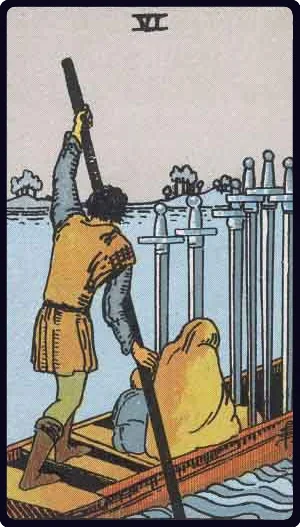
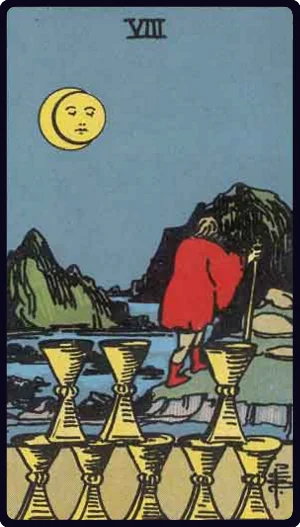
Both images contain movement, so 'walking away' is too broad to distinguish them. The Six can help you plan a passage into different conditions. The Eight can help you ask whether the direction still matters to you. Neither card requires a literal journey or establishes that leaving is the best available choice.
Compare the two questions
| Focus | Six of Swords | Eight of Cups |
|---|---|---|
| Main focus | The process and support involved in a transition. | Reconsidering emotional investment or a sense of fulfilment. |
| Image cue | Passengers are carried in a boat, with swords still on board. | A figure walks away from a group of cups. |
| Useful question | What will help me move into different conditions? | What am I still investing in, and does it remain meaningful? |
| Advice emphasis | Make the next stage more manageable and identify support. | Clarify the reason for staying, changing your involvement or leaving. |
| Easy mistake | Assuming a move will remove every difficulty. | Treating one disappointing day as proof that you must leave. |
Start with what is in the images
Six of Swords
In the Six of Swords, one figure propels a boat carrying two passengers and six upright swords. The image makes both assistance and carried material visible. A transition need not be solitary or free of unfinished concerns.
Eight of Cups
In the Eight of Cups, the cups remain in the foreground while a figure moves towards uneven land. Something is being left in place. That can prompt a question about involvement without declaring the cups worthless.
One situation, two advice cards
How should I respond to a weekly class that is no longer working for me?
You still enjoy the subject, but the travel is tiring and the group format gives you little time to practise. Another class is available closer to home. You are also unsure whether you want to continue studying this subject at all.
If Six of Swords is Advice
With the Six of Swords in Advice, explore the transition itself. Could a closer class, a different timetable or help arranging materials improve the experience? Ask what knowledge and unfinished work you would carry into the new setting. Moving classes may reduce a practical difficulty while leaving your broader question about interest open.
If Eight of Cups is Advice
With the Eight of Cups in the same Advice position, examine the investment. Do you still value learning the subject, or are you attending mainly because you have already spent time on it? Identify what feels absent before choosing a response. You might change your involvement, pause or leave, but the card does not decide among those options for you.
If both themes apply
The two themes can work in sequence: first clarify whether continuing is meaningful, then plan a supported change if you choose one. A move to better conditions and a decision to pursue a different interest are not interchangeable outcomes.
How reversals change the question
Reversed Six of Swords can prompt a check on what makes a transition difficult: missing support, unclear arrangements or an issue that will travel with you. It does not mean that progress is impossible.
Reversed Eight of Cups can invite a review of staying and returning. Is a renewed commitment based on a useful change, or on discomfort with the uncertainty of leaving? A return is not automatically a mistake.
Relationships and work
In a relationship reading
The Six can frame a change in how two people manage a difficult period: a calmer conversation, clearer routine or practical support. It cannot promise that distance will solve the issue.
The Eight can ask whether a pattern of involvement is still fulfilling. Clarify needs and options before treating the card as a verdict about the relationship or another person's feelings.
In a work reading
The Six may focus on a handover, a new team or a more manageable way of working. Identify access, training and continuity needs so that the transition has practical support.
The Eight may focus on the meaning of the work and the reasons for continuing it. A values question deserves attention, but a decision to leave still needs a realistic plan based on your circumstances.
Common shortcuts to question
- The Six is forced movement and the Eight is always freely chosen.
The images suggest different ways to explore movement; they cannot establish how much choice a person has. Ask about actual constraints.
- The Eight means the past was a waste.
Something can have been valuable and still no longer fit. Acknowledge what you learned without using past effort as the only reason to continue.
Try the distinction yourself
You want to change a study routine. Separate a question about the conditions from a question about the purpose.
Show two possible reading questions
Six of Swords: What support or arrangement would make the next stage easier to sustain?
Eight of Cups: Which part of this commitment still feels worthwhile, and which part needs reconsideration?
Name one practical condition you could change and one reason you might continue. Compare them before deciding that movement alone is the answer.
Questions about this comparison
Do Six of Swords and Eight of Cups both mean leaving?
They can both support a reading about movement, but neither requires literal departure. The Six often directs attention to a supported transition; the Eight to the meaning of continued investment.
Which card is about emotional fulfilment?
The Eight of Cups makes that question especially useful in this comparison. The Six can still involve feelings, while focusing more on the passage into different conditions.
Can the two cards appear in the same reading?
Yes. You might first reconsider what you want to invest in, then work out the support needed for a transition. Named spread positions help separate those two questions.
Keep the individual cards in view
Six of Swords in depth · Eight of Cups in depth
Explore all five comparisons · How to read two cards together
Images and interpretation
The pictured cards use Rider–Waite–Smith imagery by Pamela Colman Smith. Historical descriptions: A. E. Waite, The Pictorial Key to the Tarot, Part II and Part III. The distinctions, scenarios and exercises here are Lumina Tarot’s modern editorial interpretations. They are not quotations, universal rules or reports of consultations.