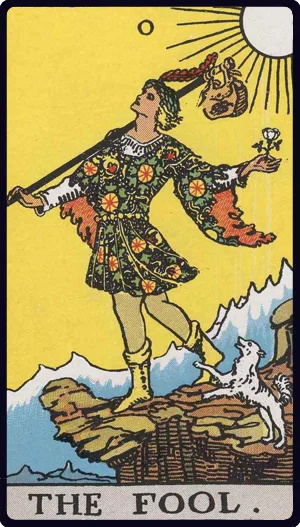
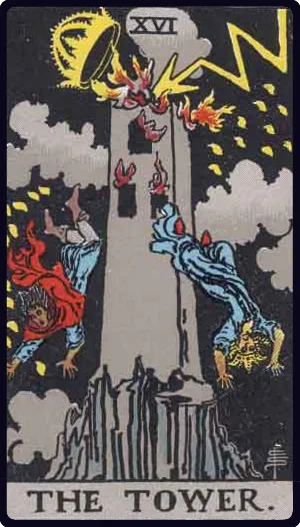
The Fool and The Tower Tarot Combination Meaning
Adjust a beginning when an assumption falls away
The Fool and The Tower connect a new attempt with a disrupted expectation. The pair asks how to respond when the starting plan proves less stable than you thought.
How the two cards interact
The Fool’s lightly equipped beginning contrasts with The Tower’s damaged structure. For this reading, look for an assumption contradicted by something that has actually happened. The Fool can help you explore what remains after acknowledging that evidence; it does not make the disruption welcome or harmless. Unlike The Hanged Man’s deliberate change of viewpoint, this example concerns a plan whose foundation can no longer be used as proposed. An ordinary delay is not, by itself, proof of a Tower-like crisis.
Love and relationships
New information may change what you want from a connection. Discuss what was misunderstood and allow either person to reconsider without turning surprise into a prediction of disaster.
Work and practical decisions
When evidence contradicts a project’s central assumption, identify which decisions depend on it. Pause those parts, tell affected collaborators what changed and check the replacement before making another promise. A small correction can be enough when the rest of the work remains sound. The Fool offers a starting point after that assessment, not a reason to treat every setback as an opportunity you must immediately pursue.
A worked reading
Question: How should I restart a community display after discovering that its central story is wrong?
Your first local-history display is built around the claim that an old hall was once a school. A dated record supplied by the local archive contradicts that claim, and several captions depend on it. Read The Tower as Situation: the central explanation needs correction, rather than a more confident presentation. Read The Fool as Advice: begin again with a smaller question you can investigate. Pause the affected captions, separate documented facts from recollections, and ask the archive for help checking the building’s use. A revised display could show what is known and what remains uncertain. This is not an invitation to discard every contribution; it is a reason to stop repeating the unsupported claim before choosing the next version.
If one or both cards are reversed
Reversed Fool may suggest another hurried restart before the replacement has been checked. Reversed Tower may prompt you to ask whether you are minimising evidence because acknowledging it would be awkward. In the display example, changing the wording without correcting the underlying claim would leave the problem intact. If both cards are reversed, establish one verified fact before choosing the next version. Reversal alone does not show that a hidden disaster exists or has been avoided.
Elemental context
- Elements used here
- The Fool: Air · The Tower: Fire
- Relationship
- Supportive
These elements can develop one another’s expression. The card images and question determine what that means in this reading.
Questions about this pair
Does the order of these cards matter?
With Situation/Advice, Fool–Tower tests the foundation of a beginning. Tower–Fool asks what modest new route remains after a particular plan changes.
Is this combination a yes or no?
A revised trial may be possible. The cards cannot predict an accident or establish that disruption will lead to success.
A question to take away
What evidence changed my understanding, and which parts of the plan actually depend on the assumption it challenged?
Choose another pair · Try a three-card spread · Draw a daily card