Physical deck exercise
How to Choose a Tarot Significator and Set Up the Draw
A tarot significator is a card that represents a person or the subject of a reading. In this exercise you choose it before you shuffle. Use a caption editor’s question to try two possible cards and see exactly what changes when you keep one on the table.
Choose the part you play in this particular question
Imagine you have agreed to caption a short film for a neighbourhood screening. You have edited the dialogue, but this is your first time timing captions. Which part of that job do you want to keep in view while you read?
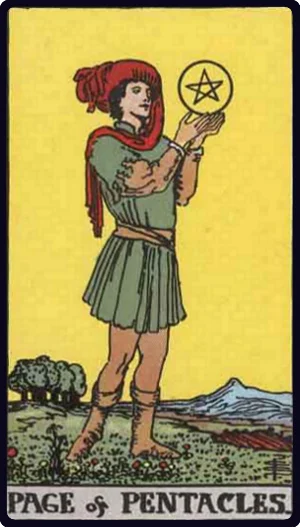
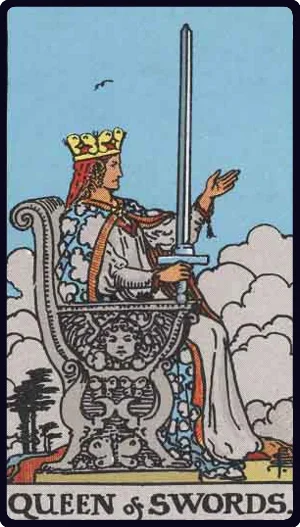
Either card could represent the same person. Pick the Page if your question is “How can I learn to time a caption that people can follow?” Pick the Queen if you are asking “How should I handle two conflicting edits?” Finish the sentence “I chose this image because, in this reading, I am the person who ___.” That sentence gives the card a job for the duration of the reading. You can use a different card next time.
If a spread already gives you a position called “My role” and you want to discover an image for it by drawing, leave that position empty until the draw. You can also skip the significator altogether. A question written on a slip of paper can hold your focus just as well.
Set up the table before shuffling
Suppose you picked the Page and plan to draw one Advice card from a complete 78-card deck. Choose how to handle the Page before turning over the Advice card.
| Your choice | What to do with the Page | What you draw |
|---|---|---|
| Keep the picture in sight | Find the Page face up. Place it beside the reading area and put a label reading “Chosen by me” underneath it. | Shuffle the remaining 77 cards and draw one for Advice. Two cards are on the table. Only Advice was drawn. |
| Keep every card available | Write “Page of Pentacles — learning caption timing” on paper. Leave the physical Page in the deck. | Shuffle all 78 and draw one for Advice. If the Page appears, record that it also filled the Advice position. |
| Use the question alone | Write the question and leave space for Advice. You do not need to choose a card to represent you. | Shuffle all 78 and draw one. Interpret it against the written question. |
A guidebook may call for a significator beneath another card or assign the first drawn card to represent the reader. Check the instructions for that particular layout. In the exercise here the chosen image sits outside the numbered positions. If you set a card aside, return it to the deck when you finish.
The caption editor’s first minute of film
In this invented reading, Ari sets the Page face up beside the deck. For Advice, the example uses the Three of Pentacles. A craftsperson stands above two figures, one holding a document. Ari takes this as a prompt to bring a sample to someone who can review the work while changes are still easy.
Ari’s note reads, “I chose the Page to remind me that timing is the skill I’m learning. For Advice, the Three of Pentacles gives me an idea for getting feedback. I’ll caption one minute, play it to a willing viewer, and ask which line disappeared before they finished reading.” The viewer can point to a time on the film. Their response gives Ari something specific to edit.
Had Ari chosen the Queen instead, the same Advice image could prompt a different conversation. Two editors have supplied different versions of a line. Ari could bring both to the director, replay the audio, and agree who signs off on the wording. The Advice card stays the same in that comparison. Choosing a different focus changes the question that the collaborators need to answer.
Check your reading notes
You write “Queen of Swords” on a slip to represent yourself as the meeting chair. You shuffle the complete deck and turn over the Queen of Swords in a position labelled “What could I practise?” How would you describe what just happened to someone who did not see the draw?
Compare your note with a worked answer
“I named the Queen before shuffling. The physical card stayed in the deck and came out in the practice position. Looking at the extended hand, I’ll invite one quieter participant to finish their thought before I summarise.” The slip records a deliberate choice. Only one physical card was drawn. A match was possible from the start and gives no independent evidence about how the meeting will go.
For a second check, set your chosen card face up, shuffle the remaining deck and draw one card for Advice. Write a note naming both. Could someone reading your note tell which card you selected yourself? If the distinction is unclear, add the labels “chosen focus” and “drawn for Advice.” The reading journal has space for the method and the cards in each position.
Where these methods come from
Tina Gong describes taking a card out of the deck to represent the person asking the question and choosing a court card for the role that person occupies in a particular situation. The Association of Independent Readers and Rootworkers also documents readers who name a card in advance and leave it in the deck. The caption-editing case and the paper-label exercise on this page are Lumina’s examples. Gong on choosing a significator · Documented significator methods.