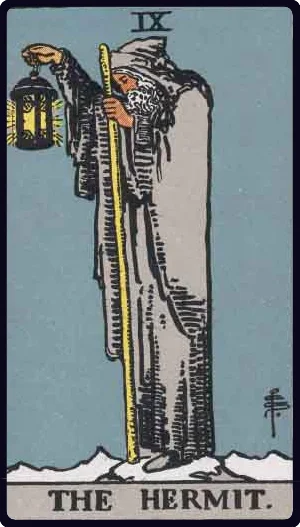

The Hermit and Temperance Tarot Combination Meaning
Using quiet reflection to rebalance daily life
The Hermit and Temperance connect a period of reflection with gradual adjustment. The Hermit creates distance from noise so you can notice what matters. Temperance asks how that insight can become a workable routine. Together, they move from understanding a need to making room for it.
How the two cards interact
The Hermit's lantern illuminates a small area rather than the whole landscape. Temperance transfers water between vessels with attention to proportion. Their shared emphasis is careful observation, but their actions differ: one steps back, the other adjusts. A useful reading asks when solitude is helping you understand a problem and when it is time to try a change in ordinary life.
Love and relationships
You may need space to identify your feelings before discussing a recurring issue. Explain that need and agree when to reconnect, so reflection does not become unexplained withdrawal. Temperance then asks what both people can adjust. The aim is a rhythm that includes private time and meaningful contact, rather than assuming that either constant closeness or distance will solve everything.
Work and practical decisions
Review how your time is actually used before choosing a new productivity system. The Hermit can represent that audit; Temperance can represent a small revision to the schedule. Protect a focused work period, reduce one recurring interruption or combine related tasks. A measured experiment provides more information than redesigning every part of your routine at once.
A worked reading
Question: Why does my weekly routine keep feeling unbalanced?
Suppose meetings have gradually displaced the time needed to finish work. The Hermit invites you to inspect a real week's calendar rather than rely on a general feeling of busyness. Temperance asks which change in proportion you can try. By agreement, replace one optional half-hour meeting with focused work in that same slot, leaving the rest of the schedule as it is. Note what you finished and what interrupted the session before deciding whether to repeat the change. That observation is more useful than declaring the routine fixed after one unusually easy week.
If one or both cards are reversed
Reversed Hermit can suggest reflection turning into avoidance or difficulty asking for another perspective. Reversed Temperance can suggest that a routine has become uneven despite good intentions. Consider whether you need clearer information, a smaller change or a conversation with someone affected by the current arrangement. More time alone is not automatically the answer.
Elemental context
- Elements used here
- The Hermit: Earth · Temperance: Fire
- Relationship
- Neutral
The elements alone do not specify support or opposition. Focus on the card images, the question and any named positions.
Questions about this pair
Does the order of these cards matter?
In Situation/Advice positions, The Hermit as Situation describes a period of review; Temperance as Advice asks you to turn one finding into a measured adjustment. With Temperance as Situation, a compromise or routine is already being tried; The Hermit as Advice asks you to examine whether it meets the need it was meant to address. Keep the positions the same so the change in emphasis comes from the cards rather than from changing the question.
Is this combination a yes or no?
This pair can support taking time to review and making a modest change. It gives less support to an urgent, sweeping commitment based only on a feeling of imbalance. Decide what you need to learn and when you will review the result.
A question to take away
What have I understood during reflection that I have not yet translated into one practical change?
Choose another pair · Try a three-card spread · Draw a daily card